




Table of Contents
- 1. INTRODUCTION TO HANDBOOK
- 2. EMPLOYMENT PRACTICES & REQUIREMENTS
- 3. EMPLOYEE CLASSIFICATION, COMPENSATION & TIME
- 4. EMPLOYEE BENEFITS & LEAVE
- 5. WORKPLACE EXPECTATIONS & OPERATIONS
- 6. EMPLOYEE CONDUCT & ETHICS
- 7. NON-DISCRIMINATION, HARASSMENT & REPORTING
- 8. SAFETY, SECURITY & EMERGENCY PROCEDURES
- 9. TEACHER EXPECTATIONS
- 10. STUDENT CONDUCT AND DISCIPLINE
- 11. STUDENT ATTENDANCE
- 12. CAMPUS PROCEDURES
- 13. INTRUCTIONAL EXPECTATIONS
- 14. GRIEVANCE AND COMPLAINT PROCEDURES
- 15. SEPARATION FROM EMPLOYMENT
Table of Contents
- 1. INTRODUCTION TO HANDBOOK
- 2. EMPLOYMENT PRACTICES & REQUIREMENTS
- 2.1 Equal Employment Opportunity
- 2.2 Accuracy of Information
- 2.3 Employment At-Will
- 2.4 Employment Application & Hiring Documentation
- 2.4 Pre-employment Affidavit
- 2.5 Background Checks & Criminal History Requirements
- 2.6 Prohibition on Certain Offenses
- 2.7 Fair Credit Reporting Act (FCRA)
- 2.8 Certifications and Licenses
- 2.9 Immigration Law Compliance
- 2.9 New Hire Reporting
- 2.10 Assignment and Reassignment
- 2.11 Authority for Bind Contracts
- 3. EMPLOYEE CLASSIFICATION, COMPENSATION & TIME
- 3.1 Employee Classification (Exempt / Non-Exempt)
- 3.2 Fair Labor Standards Act (FLSA) Compliance
- 3.3 Overtime Requirements
- 3.4 Supplemental Duties and Stipends
- 3.5 Payroll Practices (Deposits, Deductions, Reimbursements)
- 3.6 Timekeeping and Recordkeeping Requirements
- 3.7 Work Schedule, Attendance and Tardiness
- 4.EMPLOYEE BENEFITS & LEAVE
- 4.1 Health, Dental, and Vision Insurance
- 4.2 Supplemental Insurance Benefits
- 4.3 Retirement Systems (TRS and 403b)
- 4.4 Workers’ Compensation
- 4.5 Unemployment Compensation
- 4.6 COBRA
- 4.7 Holidays & School Breaks
- 4.8 Local, State and Vacation Leave
- 4.9 Family and Medical Leave Act (FMLA)
- 4.10 Military Leave
- 4.11 Bereavement Leave
- 4.12 Jury Duty, Court Appearances, and Voting Leave
- 4.13 Same-Sex Spouse Benefits
- 5. WORKPLACE EXPECTATIONS & OPERATIONS
- 6. EMPLOYEE CONDUCT & ETHICS
- 6.1 Standard Employee Conduct
- 6.2 Fraud, Dishonesty, and False Statements
- 6.3 Insubordination
- 6.4 Conflict of Interest
- 6.5 Employment of Relatives (Nepotism/Fraternization)
- 6.6 Workplace Dating and Consensual Relationships
- 6.7 Former Employees
- 6.8 Workplace Investigations
- 6.9 Reporting Employee Misconduct (Non-Educators and Service Providers)
- 6.9.1 Reportable Misconduct (Non-Educators)
- 6.9.2 Principal Reporting Responsibilities (48-Hour Notice)
- 6.9.3 Superintendent Reporting Responsibilities (TEA / DFPS / Law Enforcement)
- 6.9.4 Investigation and Coordination with TEA / DFPS
- 6.9.5 Mandatory Reporting Under Texas Law
- 6.9.6 Corrective Action and Safety Measures
- 6.9.7 Confidentiality, Cooperation, and Retaliation
- 6.10 Whistleblower Protection
- 6.11 Tobacco, Nicotine, and E-Cigarette Use
- 6.12 Drug-Free Workplace
- 6.13 Employee Searches
- 6.14 Fundraising and Money Handling
- 7. NON-DISCRIMINATION, HARASSMENT & REPORTING
- 7.1 Non-Discrimination and Title IX Compliance
- 7.2 ADA Compliance
- 7.3 Harassment Prohibition
- 7.3.1 Retaliation
- 7.3.2 Reporting Discrimination and/or Harassment
- 7.4 Sexual Harassment Policy and Procedures
- 7.4.1 General Definitions
- 7.4.2 Reporting Sexual Harassment
- 7.4.3 Notice of Allegations
- 7.4.4 Emergency Removals
- 7.4.5 Informal Resolution
- 7.4.7 Confidentiality
- 7.5 Student Harassment & Discrimination
- 7.6 Child Abuse, Neglect, and Maltreatment Reporting
- 7.7 Sexual Abuse and Child Safety Requirements
- 7.4 Sexual Harassment Policy and Procedures
- 7.8 Reporting an Educator’s Misconduct
- 7.8.1 Educator Professional Standards and Misconduct Overview
- 7.8.2 Reportable Conduct and Misconduct Definitions
- 7.8.3 Principal Reporting Responsibilities (48-Hour Requirement)
- 7.8.4 Superintendent Reporting Responsibilities (TEA / SBEC Mandatory Reporting)
- 7.8.5 Investigation Requirements and Law Enforcement Coordination
- 7.8.6 Required Notifications
- 7.8.7 Confidentiality, Retaliation, and Cooperation
- 7.8.8 Pre-Employment Disclosure Requirement
- 7.9 Staff/Student Relationships
- 7.10 Sexual Harassment of Students
- 7.11 Student Welfare: Reports of Child Pornography
- 7.12 Sexual Abuse and Maltreatment of Children
- 7.13 Employee Require Training
- 8. SAFETY, SECURITY & EMERGENCY PROCEDURES
- 8.1 School Security
- 8.2 Campus Security
- 8.3. Classroom Security and Student Supervision
- 8.4 Emergency Operations Plan (EOP)
- 8.5 Workplace Violence and Weapons Policy
- 8.6 Access Cards, Keys, and Building Access
- 8.7 Audio/Video Recording Policies
- 8.8 Use of Personal Vehicles for School Business
- 8.9 School Closures and Emergency Operations
- 9. TEACHER EXPECTATIONS
- 10. STUDENT CONDUCT AND DISCIPLINE
- 11. STUDENT ATTENDANCE
- 12. CAMPUS PROCEDURES
- 13. INTRUCTIONAL EXPECTATIONS
- 13.1 Lesson Plans
- 13.2 Homework
- 13.3 Substitute Folders
- 13.4 Movies/Videos in Class
- 13.5 Textbooks and Instructional Materials
- 13.6 Planning
- 13.7 Special Rules for Social Studies Courses
- 13.8 Calculations of Student Grades
- 13.9 Posting Weekly Grades
- 13.10 Parent-Teacher Communication Regarding Student Progress
- 13.11 Family Educational Rights and Privacy Act
- 13.12 Copy Room
- 13.13 Lamination
- 13.14 Supply Request
- 13.15 Textbook and Materials Acquisition
- 13.16 Copyrighted Material
- 14. GRIEVANCE AND COMPLAINT PROCEDURES
- 14.1 General Provisions
- 14.2 Complaint Definition
- 14.3 Business Days
- 14.4 Filing Procedures
- 14.5 Representation
- 14.6 Consolidation of Complaints
- 14.7 Untimely Filings
- 14.8 Response Requirements
- 14.9 Costs
- 14.10 Documentation
- 14.11 Nature of Process
- 14.12 Records Retention and Public Information Compliance
- 15. SEPARATION FROM EMPLOYMENT
Employee Handbook 2026 - 2027
A MESSAGE FROM THE
SUPERINTENDENT
Justin G. Fuentes | Superintendent of Schools
Greetings APV-FFL Family,
Thank you for choosing to be part of the Amigos Por Vida – Friends For Life community. Whether you are returning for another year or joining us for the first time, please know how deeply valued you are. The work you do each day has a lasting impact on our students, families, and one another, and we are grateful to have you on this journey with us.
As we begin a new school year together, we want to ensure that you feel prepared, supported, and ready for success. One important resource is the Employee Handbook, which serves as a guide for navigating your daily responsibilities and understanding the expectations that help us work effectively as a team. It also provides important information regarding professional relationships, communication, and partnerships with colleagues, students, and families.
As you review the handbook, please note that several updates have been made based on feedback gathered through district surveys, staff input, and other stakeholder engagement processes. We value your voice and continuously strive to improve our systems and practices, so we encourage you to read the handbook carefully, even if you have reviewed previous editions.
As we look ahead, we are incredibly excited to build upon the strong foundation that has been established at APV-FFL over nearly three decades. Each of you plays a vital role in shaping and strengthening our culture. Together, we will continue creating an environment where every student is encouraged to be Responsible, Respectful, and Ready—not only in their academic pursuits, but also in their social-emotional growth and development.
Thank you for your commitment, your passion, and your belief in our students. We look forward to a year of learning, growth, and success together.
With gratitude and excitement,
Justin G. Fuentes
Superintendent of Schools, APV-FFL
1. INTRODUCTION TO HANDBOOK
The purpose of this personnel handbook is to provide employees with a source of information about Amigos Por Vida – Friends For Life Public Charter School’s procedures and policies. The policies and procedures in this handbook are to serve as guidelines and address the minimum requirements established by applicable or relevant legal requirements and best practice. Although St has tried to be comprehensive, the handbook does not, and cannot, include procedures and policies which address every situation that may arise. Such a list would be limitless.
APV – FFL has, and reserves, the right to adopt new procedures and policies, or modify, alter, change or cancel existing policies and procedures at any time. Violation of any board policy or a provision within this handbook may lead to disciplinary action up to and including discharge from employment.
Questions regarding this handbook or any of the policies/procedures should be directed to the employee’s supervisor or to the Human Resources Department.
1.1 School Governance
The Texas Education Agency Charter APV-FFL. The School Board is composed of three to seven members who assist the principal with the school’s operation, through a model of shared governance. If the Board of Directors makes no specific determination, there will be five acting Board positions.
1.2 Mission Statement
Our purpose is to empower our students to become life-long learners and to achieve academic and personal success by providing an excellent education in a safe environment.
1.3 Organization Chart
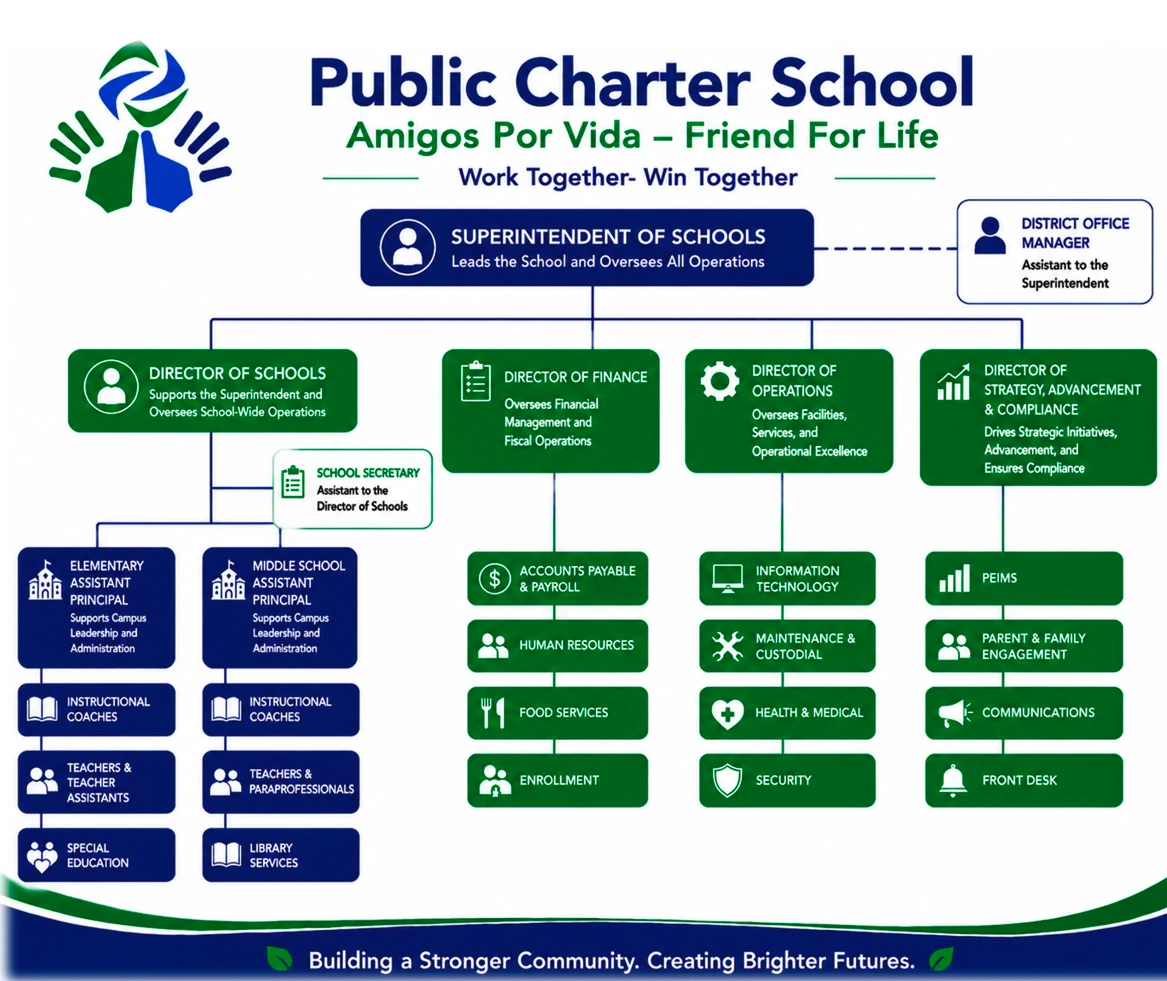
1.4 School Creed for Students
I believe in myself and my ability to do my best at all times. Today, I will be Responsible, Respectful, and Ready.
Amigos Por Vida Employs: Highly motivated individuals invested in the school community and want to make an impact on our students’ academic performance. These professionals operate under a “whatever it takes” mindset to ensure our students experience academic success. Our teachers are data driven and have high expectations for all students. They believe they are the key ingredient to student achievement. Our other professionals provide the necessary support, information, and assistance for all stakeholders to be involved in the school’s mission.
1.5 Open Door Policy
APV – FFL has adopted an Open Door Policy for all employees. The purpose of our Open Door Policy is to encourage open communication, feedback, and discussion about any matter of importance to an employee. Our Open Door Policy means that employees are encouraged to bring any workplace concerns or problems they might have or know about to their supervisor or some other school administrator.
APV – FFL values each employee and strives to provide positive work experience. By listening to Employees, APV – FFL can improve, to address complaints, and to foster employee understanding of the rationale for practices, processes, and decisions. The Open Door Policy is not a substitute for a formal complaint. If an employee has a formal complaint or grievance, the employee should timely pursue it in accordance with Section 11 of this Handbook.
1.6 Employee Handbook Receipt
The information contained in this personnel handbook is important and I should consult with my immediate supervisor, Superintendent, CFO, or the Human Resources Department if I have a question that is not answered in this handbook.
I acknowledge that the APV – FFL personnel handbook does not create an employment contract or otherwise modify my at-will employment status.
I understand that no one has the authority to alter my at- will employment status, or to guarantee my employment for a specific period, unless it is approved by the board of directors, in writing, and signed by both me and the chair of the board of directors. I understand that my employment may be terminated at the will of either party, with or without cause, and without prior notice. I understand that APV- FFL may amend or withdraw any or all portions of this handbook at any time. I understand that it is my responsibility to comply with the board policies and the provisions in this handbook, including any revisions, and that failure to comply may lead to disciplinary action. I further acknowledge that any revised information may supersede, modify, or eliminate existing provisions within this handbook. By remaining employed by APV – FFL following any modifications to this handbook, I therefore accept and agree to such changes.
I acknowledge that I have read this handbook and agree to read any amendments to the handbook. Specifically, by signing this form, I acknowledge that I have read, understood, and agreed to comply with all policies in this handbook, including but not limited to, the Harassment Policy, the Overtime and Timekeeping Policy, the Violence in the Workplace Policy, and the Electronic Media, Communications Systems, and Technology Resources Acceptable Use Guidance. Finally, in the event of any inconsistency between the information, policies, and benefits described in this Handbook and in my Employment Agreement, the information, policies, and benefits described in the Employment Agreement will supersede.
I understand that I have an obligation to timely inform Human Resources of any changes in personal information, such as phone number, address, etc. I also accept responsibility for contacting my supervisor or the Human Resources Department if I have questions or concerns or need further explanation concerning the contents of this Employee Handbook or my employment with APV-FFL.
I have received training and fully understand the contents of the Amigos Por Vida – Friends for Life Public Charter School Employee Handbook. I have read and received an electronic copy of the handbook. I hereby sign and date this Acknowledgment of Receipt and return it to the Human Resources Department. I understand that a copy of my signed form will be retained in my personnel file.
2. EMPLOYMENT PRACTICES & REQUIREMENTS
2.1 Equal Employment Opportunity
APV – FFL is an equal opportunity employer. It is the policy of the APV – FFL to afford equal employment and advancement opportunity to all qualified individuals without regard to:
- Race (including traits historically associated with race, such as hair texture and hairstyle, including but not limited to braids, locks, and twists)
- Color
- Gender (including gender identity, gender expression, and transgender identity, whether the employee is transitioning or has transitioned)
- Sex (including pregnancy, childbirth, breastfeeding, and medical conditions related to such);
- Religious creed (including religious dress and grooming practices)
- Marital/registered domestic partner status
- Age (forty (40) and over)
- National origin or ancestry (including native language spoken and possession of a driver’s license issued to persons unable to prove their presence in the U.S. is authorized by federal law)
- Physical or mental disability (including HIV and AIDS
- Medical condition (including cancer and genetic characteristics)
- Taking of a leave of absence pursuant to the Family Medical Leave Act (“FMLA”), Pregnancy Disability Leave (“PDL”) law, Americans with Disabilities Act (“ADA”), or laws related to domestic violence, sexual assault and stalking
- Genetic information
- Sexual orientation
- Military and veteran status; or
- Any other consideration is made unlawful by federal, state, or local laws
2.2 Accuracy of Information
APV – FFL relies upon the accuracy of the information contained in the employment application, as well as the accuracy of other information presented throughout the hiring process and employment. Employees are expected to provide truthful and accurate information in connection with their employment at APV – FFL.
Any falsification or misrepresentation in connection with application materials, or while employment, is a serious offense and may lead to discharge from employment or non-selection of an applicant.
Employment with Amigos Por Vida – Friends For Life Public Charter School – shall be at-will unless a term of employment is expressly stated in a written contract. At-will employment means that an employee may be terminated with or without cause, with or without prior notice, at any time, for any reason or for no reason. Similarly, employment with Amigos Por Vida – Friends For Life Public Charter School is voluntarily entered, and employees are free to resign at any time, with or without cause or notice.
2.3 Employment At-Will
Status as an at-will employee may not be changed except in writing signed and approved by the Board of Directors. Employment at-will is the sole and entire agreement between Amigos Por Vida – Friends For Life Public Charter School and employees concerning the duration of employment, and the circumstances under which employment may be terminated.
Nothing in this Handbook is to be construed as creating an employment contract or agreement. No one other than the Board of Directors and/or the Superintendent has the authority on behalf of Amigos Por Vida – Friends For Life Public Charter School to alter an employee’s at-will employment arrangement, to enter into an agreement for employment for a specified period of time, or to make any agreement contrary to this policy, and any such agreement must be in writing and must be signed by the Board of Directors and/or the Superintendent.
2.4 Employment Application & Hiring Documentation
Those seeking employment with APV-FFL Public School can log on to the APV-FFL website at Pre Employment Application – Amigos por Vida.
Applicants must be 18 years of age or older to be considered for employment. Applicants will be required to reapply after their application has been filed for a year.
APV-FFL reserves the right to terminate any employee or decline to employ an applicant if the person falsifies any information on the application or on any other employment related documentation or fails to disclose any criminal activity or misrepresents information regarding any such charge or conviction on an employment application.
New employees are asked to review and/or complete the following forms:
- Pre-employment Application
- Pre-employment Affidavits
- I-9 Employment Eligibility Form (“EEVF”) required by the Department of Homeland Security
- W-4 Employee’s Withholding Allowance Certificate
- Signed offer letter
- Acknowledgement of Receipt of Personnel Handbook
- Direct Deposit Information Form
- Applicable Healthcare/Benefit Forms
- Notice of Workers’ Compensation Benefits
- Authorization for Criminal History Background Check
Current employees may be required to update or execute any of the above forms. Any employee who fails or refuses to complete the above forms or provides APV – FFL with requested documentation in a timely manner may be subject to the loss of employment benefits, the delay of employment benefits, disciplinary action, or withdrawal of the employment offer.
2.4 Pre-employment Affidavit
All applicants for employment for educator positions (as defined by Texas Education Code §21.003) must submit a pre-employment affidavit indicating whether the applicant has ever been charged with, or adjudicated for, having an inappropriate relationship with a minor.
An applicant offered employment for an educator position (as defined by Texas Education Code §21.003) must submit a Pre-Employment Affidavit for Applicant Offered Employment prior to the start of employment with APV – FFL. The Pre-Employment Affidavit must be signed by a notary public. APV – FFL offers applicants the opportunity to have the affidavit notarized for free by APV – FFL.
2.5 Background Checks & Criminal History Requirements
APV – FFL will obtain criminal history records from a law enforcement or criminal justice agency for all prospective volunteers and applicants for employment, including substitutes, as required by Chapter 22 of the Texas Education Code prior to employment or the commencement of volunteer service. Additionally, as allowed by state law, criminal history checks of employees (or volunteers whose duties are performed where students are regularly present) may be obtained at any time during employment or volunteer services.
Information collected on an individual to comply with the requirements listed above is confidential and may not be released except as authorized by law or with the consent of the person who is the subject of the information.
All employees and applicants must complete the Authorization for Criminal History Background Check form accompanying this Handbook. Nobody may be placed in a classroom or interact with students until a background check has been completed.
2.6 Prohibition on Certain Offenses
APV – FFL may not hire an individual who is prohibited from serving as an officer or employee of an open-enrollment charter school under Texas Education Code § 12.120(a). Additionally, APV – FFL shall discharge or refuse to hire an employee or applicant for employment if it obtains information through a criminal history review that:
- The employee or applicant has been convicted of or placed on deferred adjudication community supervision for an offense for which a defendant is required to register as a sex offender under Chapter 62, Code of Criminal Procedure; or
- The employee or applicant has been convicted of: – A felony under Penal Code Title 5, if the victim of the offense was under 18 years of age at the time the offense was committed, or – An offense under the laws of another state or federal law that is the equivalent to an offense under item 1 above (relating to registration as a sex offender).
APV – FFL may make employment decisions in accordance with its policy regarding the employment of individuals with criminal histories, including those who have been arrested, charged with, or convicted of a criminal offense. Consistent with Texas law and rules adopted by the
Commissioner of Education, a person may not serve as an APV – FFL officer or employee if the person has been convicted of any of the following offenses:
A misdemeanor involving moral turpitude or any felony.
An offense listed in Texas Education Code § 37.007(a).
An offense listed in Code of Criminal Procedure, Article 62.001(5)
Additionally, APV – FFL shall discharge or refuse to hire a person listed on the registry of persons not eligible for employment in Texas schools, as maintained and made available by the Texas Education Agency (“TEA”).
APV – FFL may discharge an employee if it obtains information of the employee’s conviction of a felony or misdemeanor involving moral turpitude that the employee did not disclose to APV- FFL or the State Board of Educator Certification (“SBEC”).
Except as required by state or federal law or as determined by APV – FFL to be in the best interest of student and employee safety (and in accordance with applicable law), APV – FFL does not automatically prohibit employment or refuses to consider an application for employment solely on the grounds that an applicant/employee has a prior criminal record. APV – FFL does not prohibit employment or refuse to consider an application for employment based solely on the grounds that the applicant/employee has been arrested. Instead, APV – FFL reviews these circumstances on a case-by- case basis.
APV – FFL reserves the right to annually (or more frequently) perform criminal history record checks on current employees.
2.7 Fair Credit Reporting Act (FCRA)
APV – FFL may obtain and review consumer reports, including criminal history records, employment references, credit reports (when permitted by law and relevant to the position), and Department of Public Safety (DPS) records, to assist in employment-related decisions. In addition, APV – FFL may conduct periodic or annual driving record reviews for employees whose job duties require the operation of school-owned or school-authorized vehicles to ensure that their driver’s licenses remain valid, and their driving records meet the requirements of APV – FFL and the insurance carrier.
Where required by applicable law, prior to running any of the above-mentioned checks/records, each employee will be provided with any required notice form(s) and must sign an authorization form at the time of the initial job interview or prior to extending an offer of employment. Refusal to sign such authorization is grounds for disqualification from employment with APV – FFL Continued employment is also expressly conditioned on satisfactory results from legally authorized or required record and background checks.
If APV – FFL intends to take an adverse employment action based, in whole or in part, on information contained in a consumer report, as defined by the Fair Credit Reporting Act (FCRA), including but not limited to the denial of employment, reassignment, denial of promotion, or termination of employment, APV – FFL will comply with all applicable FCRA requirements and take the appropriate steps required by law before and after such action is taken.
Step1: Before taking adverse action, the employee will be provided a pre-adverse action disclosure that includes a copy of the individual’s consumer report and a copy of “A Summary of Employees Rights Under the Fair Credit Reporting Act” – a document prescribed by the Federal Trade Commission.
Step 2: After taking an adverse action, the employee will be provided notice – either orally, in writing, or electronically – that the action has been taken. This notice will include:
- The name, address and telephone number of the Credit Reporting Agency “CRA” that supplied the report
- A statement that the CRA supplying the report did not make the decision to take adverse action, and cannot give specific reasons for it; and
- A notice of the individual’s right to dispute the accuracy or completeness of any information the agency furnished, and his or her right to an additional free consumer report from the agency upon request within 60 days.
The employee will be given a reasonable amount of time to refute the information. However, it is ultimately the decision of APV – FFL as to what action is taken.
2.8 Certifications and Licenses
Employees whose positions require certification through the State Board for Educator Certification (“SBEC”), or another professional license are responsible for taking actions to ensure their credentials do not lapse. It is solely the employee’s responsibility to maintain a valid certification or license. An employee’s employment may be terminated if he or she falsely represents holding a valid certificate or license or fails to fulfill the requirements necessary to renew or extend a certificate or license. Employment may also be terminated if SBEC suspends or revokes an employee’s certification.
2.9 Immigration Law Compliance
APV – FFL will comply with applicable immigration law, including the Immigration Reform and Control Act of 1986 and the Immigration Act of 1990. As a condition of employment, every individual must provide satisfactory evidence of their identity and legal authority to work in the United States. However, APV – FFL will not check the employment authorization status of current employees or applicants who were not offered positions with APV – FFL unless required to do by law.
APV – FFL shall not discharge an employee or in any manner discriminate, retaliate, or take any adverse action (e.g., threatening to report the suspected citizenship or immigration status of an employee or a member of the employee’s family) against any employee or applicant for employment because the employee or applicant exercised a right protected under applicable law.
Further, APV-FFL shall not discriminate against any individual because they hold or present a driver’s license issued per Vehicle Code § 12801.9 to persons who have not established their federally authorized presence in the United States.
Finally, in compliance with the Immigrant Worker Protection Act, the School shall not allow a federal immigration enforcement agent to enter any nonpublic areas of the APV – FFL without a judicial warrant, or voluntarily give consent to an agent to access, review or obtain employee records without a subpoena or judicial warrant.
If a search of employee records is authorized by a valid subpoena or judicial warrant, APV – FFL will give employees notice of the inspection both before and after it has occurred as required by law.
2.9 New Hire Reporting
APV-FFL complies with federal and state requirements regarding new hire reporting. As required by law, APV-FFL must report information regarding all newly hired, rehired, or returning employees to the appropriate state reporting agency, including the Texas Employer New Hire Reporting Operations Center within the Office of the Attorney General.
Employees are responsible for providing accurate and complete employment information necessary for required reporting and maintaining updated personal information with Human Resources. APV-FFL will submit the required new hire reports within the timeframe established by applicable laws and regulations.
2.10 Assignment and Reassignment
All personnel are subject to assignment and reassignment by the Superintendent or designee and may also be directed to perform additional or supplemental duties. Unless specifically required by applicable law or approved by the Board of Directors and/or the Superintendent, no additional financial compensation is provided for additional or supplemental duties. APV-FFL’s criteria for approval of reassignments will be consistent with school policy regarding equal opportunity employment.
Any employee may request reassignment to another position for which he or she is qualified. All interested employees who meet a position’s minimum qualifications are encouraged to apply. Selection is based on the school’s needs and a candidate’s qualifications and performance. Decisions concerning job vacancies will be based on everyone’s job qualifications, experience, and abilities and in accordance with applicable state and federal law. APV – FFL reserves the right to select candidates from outside the school.
2.11 Authority for Bind Contracts
Only the charter school board of directors, acting as a body corporate, has legal authority to bind the charter school to a financial or contractual obligation. Accordingly, no school employee is authorized to bind the charter school to any financial or contractual obligation unless the board of directors has expressly and explicitly delegated contracting authority to that employee through the adoption of board policy or through other formal board action.
3. EMPLOYEE CLASSIFICATION, COMPENSATION & TIME
Texas Public Charter Schools are subject to the Federal Fair Labor Standards Act (FLSA), which governs minimum wage, overtime pay, employee classification, and recordkeeping requirements. The FLSA is enforced by the U.S. Department of Labor and applies to all covered employees of APV–FFL regardless of funding source, campus assignment, or work schedule.
APV–FFL is committed to complying with all applicable federal, state, and local wage and hour laws, including regulations and guidance related to employee classification, compensation, overtime, and recordkeeping.
3.1 Employee Classification (Exempt / Non-Exempt)
Employee classification as exempt or non-exempt is determined under federal law based on both salary requirements and actual job duties. Employees who do not meet the legal requirements for exemption are classified as non-exempt and are eligible for overtime compensation.
As of 2026, the federal salary threshold for exemption remains approximately $684 per week ($35,568 annually). Employees who do not meet both the required salary threshold and applicable duties test are generally classified as non-exempt and are eligible for overtime compensation under the FLSA.
Positions commonly classified as non-exempt (overtime eligible) may include:
- Paraprofessionals and aides
- Support and office staff
- Custodial and maintenance staff
- Food service workers
Non-exempt employees are required to accurately record all hours worked, including:
- Before- and after-school duties
- Campus events and extracurricular assignments
- Required training, meetings, or work performed outside the regular schedule
Working “off the clock” is strictly prohibited.
Non-exempt employees may be required to work beyond their regularly scheduled workday or workweek as operational needs require. Overtime eligibility is based on actual hours worked and is calculated in accordance with applicable federal and state law.
All overtime work should be approved in advance by the employee’s direct supervisor whenever possible. APV–FFL compensates non-exempt employees at one and one-half times the employee’s regular rate of pay for all hours worked over forty (40) in a workweek.
APV–FFL will make reasonable efforts to distribute overtime opportunities fairly while considering operational needs and employee schedules.
Positions commonly classified as Exempt (not eligible for overtime) may include:
- Teachers qualifying under the professional exemption
- Administrators, including principals, directors, and central office leadership
- Certain instructional specialists or licensed professionals who meet the applicable duties test
Exempt employees may be required to work beyond normal schedules as necessary to fulfill assigned responsibilities and operational needs. Exempt employees are compensated on a salary basis and are not eligible for overtime compensation.
3.2 Fair Labor Standards Act (FLSA) Compliance
Texas Public Charter Schools are subject to the Federal Fair Labor Standards Act (FLSA), which governs minimum wage, overtime pay, employee classification, and recordkeeping requirements. The FLSA is enforced by the U.S. Department of Labor and applies to all covered employees of APV–FFL regardless of funding source, campus assignment, or work schedule.
APV–FFL is committed to complying with all applicable federal, state, and local wage and hour laws, including regulations and guidance related to employee classification, compensation, overtime, and recordkeeping.
3.3 Overtime Requirements
Under FLSA, non-exempt employees must be paid at least the applicable minimum wage for all hours worked and must receive overtime compensation at one and one-half times their regular rate of pay for all hours worked over 40 in a workweek.
Overtime eligibility is determined by actual hours worked and is not based on daily schedules, assigned calendars, or campus operating hours. All compensable work hours must be included in overtime calculations when applicable.
3.4 Supplemental Duties and Stipends
APV–FFL may assign supplemental duties such as coaching, tutoring, club sponsorships, or extracurricular responsibilities.
For exempt employees, supplemental duties may be compensated through stipends in accordance with the district compensation plan, provided the employee’s exempt classification is maintained.
For non-exempt employees, all supplemental duties must be compensated in accordance with applicable wage and hour laws. All hours worked in any capacity, including supplemental assignments, must be counted toward overtime calculations when applicable. Stipends do not replace overtime obligations.
Supplemental assignments do not create a guarantee of continued assignment and may be modified or discontinued at the discretion of APV–FFL.
3.5 Payroll Practices (Deposits, Deductions, Reimbursements)
As required by law, the APV – FFL shall withhold Federal Income Tax, State Income Tax, Social Security (FICA), Medicare, and other statutory deductions, as required by law.
- Federal Income Tax Withholding: The amount varies with the number of exemptions the employee claims and the gross pay amount.
- Medicare Tax: The Federal Insurance Contribution Act requires that a certain percentage of employee earnings be deducted and forwarded to the federal government, together with an equal amount contributed by the APV – FFL
- Teachers Retirement System (STRS) or Social Security: Employee retirement contributions to the State of Texas Teachers Retirement System (STRS) are withheld for eligible employees, as required by law. See further information about this retirement program below. Any earnings that are eligible for STRS are not covered under social security. As a result, no social security is withheld from employee pay for these earnings. However, for any employees who do not qualify for STRS, social security contributions are withheld at the mandated rate.
- Child support and spousal maintenance, if applicable
- Delinquent federal education loan payments, if applicable
Other payroll withholdings cover the employee’s share of premiums for health, dental, life, and vision insurance; annuities; and higher education savings plans or prepaid tuition programs. Salary deductions may also be made for unauthorized or unpaid leave in accordance with applicable law.
Every deduction from an employee’s paycheck is explained on the check voucher. If an employee does not understand the deductions, he or she should ask the Payroll Clerk to explain them.
Employees may change the number of withholding allowances claimed for Federal Income Tax purposes at any time by filling out a new W-4 form and submitting it to the Operations Manager. The office maintains a supply of these forms.
All Federal, State, and Social Security/Medicare taxes will be automatically deducted from paychecks. The Federal Withholding Tax deduction is determined by the employee’s W-4 form. The W-4 form should be completed upon hire, and it is the employee’s responsibility to report any changes in filing status to the Operations Manager and to fill out a new W-4 form.
At the end of the calendar year, a “withholding statement” (W-2) will be prepared and forwarded to each employee for use in connection with preparation of income tax returns. The W-2 shows Social Security information, taxes withheld and total wages.
3.6 Timekeeping and Recordkeeping Requirements
By law, APV – FFL is obligated to keep accurate records of the time worked by non-exempt employees. Such employees shall keep being required to utilize the APV – FFL’s timecard system. Non-exempt employees must accurately clock in and out of their shifts as this is the only way the payroll department knows how many hours each employee has worked and how much each employee is owed. The timecard indicates when the employee arrived and when the employee departed. All non-exempt employees must clock in and out for arrival and departure, along with lunch and for absences like doctor, dentist appointments, lunch, running errands, transporting children to or from day care/APV – FFL. All employees are required to keep the office advised of their departures from and return to the APV – FFL premises during the workday.
Non-exempt employees are solely responsible for ensuring accurate information on their timecards and remembering to record time worked. If an employee forgets to mark their timecard or makes an error on the timecard, the employee must contact the supervisor and HR to make the correction. The timecard correction must be signed by both the employee and the Administrator. Failure to provide WRITTEN notice to Employees supervisor and HR of any time clock issues may subject to disciplinary actions and/or termination.
Non-exempt employees are prohibited from performing off-the-clock work, including but not limited to checking emails before/after work hours, performing work in the morning before logging in, and running APV – FFL errands after logging out.
Altering, falsifying, tampering with time records, or recording time on another employee’s time record may result in disciplinary action, up to and including termination of employment. Any employee who violates any aspect of this policy may be subject to disciplinary action, up to and including release from at will employment with the APV – FFL.
3.7 Work Schedule, Attendance and Tardiness
APV – FFL has a standard work week of forty (40) hours per week. Scheduled hours for employees may vary from department to department.
- During the school year, standard hours of operation are Monday - Friday from 7:00 a.m. until 5:00 p.m.
- During the summer (June and July), standard hours of operation in the administrative office areas are Monday - Thursday from 7:00 a.m. until 5:00 p.m.
Exempt employees are required to work the hours necessary to complete their assigned work to the satisfaction of their supervisor without any scheduling or expectation of additional compensation.
All full-time, non-exempt employees generally work a Monday through Friday schedule of forty (40) hours divided into (5) eight-hour workdays unless a different schedule is approved in writing by the employee’s supervisor. Non-exempt employees must have prior written approval before working overtime.
All employees must clock in and out at their designated time and are expected to be present at work during their scheduled hours unless otherwise required or approved by their supervisor. Employees will not be counted as present until their clock in and leave are adjusted accordingly.
All employees, whether exempt or non-exempt, are expected to arrive at work consistently and on time. Absenteeism and tardiness negatively affect the APV – FFL’s ability to implement its educational program and disrupts consistency in students’ learning.
Subject to disciplinary actions and/or termination:
- Clocking-in or clocking-out for another person is a violation of APV - FFL policy
- Failure to clock out when leaving campus during the APV - FFL workday for non-work-related activities and failing to clock-in upon returning, such as eating lunch, running errands, and transporting children to or from day care
- Failure to provide WRITTEN notice to Employees supervisor and HR of any time clock issues such as clocking in late, clocking in early, forgetting to clock in or clock out, or any other shift time management issue.
All employees are obliged to report to work every day on time and be reliable. If an employee is late to work or is unable to work as scheduled, they should notify their supervisor immediately.
APV-FFL acknowledges that illness or other personal events may lead to unscheduled absences. As such, APV – FFL has a leave policy. It is the expectation of the charter APV – FFL that each employee attends work every day, except for approved paid or unpaid leave granted in accordance with the charter APV – FFL’s leave policy.
When employees who have not given advance notice find that they cannot report for work, they are required to notify their direct supervisor and/or the Principal within the first working hour each day of their absence. Notifying an employee that is not their appropriate supervisor and/or Principal is insufficient.
Excessive absenteeism, tardiness and leaving work before designated time are disruptive to the operations of APV – FFL and may lead to disciplinary action, up to and including discharge from employment. Failure to report to work for up to three consecutive days (unless prevented by circumstances beyond the employee’s control) without notice will constitute job abandonment and/or voluntary resignation on the last day worked, in accordance with applicable federal and state law, and APV – FFL shall process the work separation as a voluntary resignation on the employee’s part.
If an employee resigns or abandons the job, they will not receive payment for any accrued or unused sick leave or any other type of leave, regardless of whether they provided advance notice of their resignation.
No payment shall be made for accrued or unused sick leave or any other type of leave upon voluntary resignation or job abandonment, regardless of whether the employee provided advance notice of resignation.
4.EMPLOYEE BENEFITS & LEAVE
4.1 Health, Dental, and Vision Insurance
APV-FFL offers group health insurance coverage to qualified employees and contributes to their medical insurance premiums. The health insurance plan year is from January 1st through December 31st. Detailed descriptions of insurance coverage, prices, and eligibility requirements are provided to all employees online in a separate booklet titled Benefits Guide, available upon request.
Eligibility
Medical coverage is available to employees who work a minimum of 30 hours per week. All employees of eligibility can make changes in their insurance coverage during the Annual Enrollment period or when they experience a qualifying life event (e.g., marriage, divorce, birth). Employees should contact Human Resources for more information.
Medical benefits coverage will be available to new hires on the first day of the month after they have worked for 30 days. New employees must register within the first 30 days of employment.
Employees who transition from part-time to full-time employment become eligible for full benefits on the first day of the month following the effective date of the change. An enrollment form must be submitted to Human Resources as soon as possible. This form serves as a request for coverage and authorizes any payroll deductions necessary to pay for coverage.
4.2 Supplemental Insurance Benefits
At their own expense, employees may enroll in supplemental insurance programs for health, dental, vision, supplemental life, spouse life, child life and other supplemental plans. Premiums for these programs are paid by payroll deductions. Employees should contact Human Resources for more information.
4.3 Retirement Systems (TRS and 403b)
4.3.1 Teacher Retirement System (TRS)
The Teacher Retirement System of Texas (TRS) provides retirement, disability, and survivor benefits for eligible employees of Texas public educational institutions. APV – FFL participates in TRS and will make all required employer contributions in accordance with applicable state laws and regulations.
Employees who are planning for retirement or retirees considering employment with APV – FFL should contact Human Resources for information regarding retirement eligibility, benefits, and the school’s Retire/Rehire procedures. Additional information about TRS benefits and services is available directly through the Teacher Retirement System of Texas.
Employees can contact TRS by calling 800-223-8778 or 512-542-6400. TRS information is also available on the web at Home | Teacher Retirement System of Texas.
Employees convicted of certain felony offenses involving misconduct against a student may be ineligible to receive a retirement annuity from the Teacher Retirement System of Texas (TRS), as provided by applicable law. Qualifying offenses may include, but are not limited to, continuous sexual abuse of a child or children, an improper relationship between an educator and a student, sexual assault, aggravated sexual assault, or other offenses specified under Texas law. Employees are encouraged to consult TRS or legal counsel for additional information regarding eligibility and benefit restrictions.
4.3.2 403(b) Retirement Plan
APV – FFL offers a voluntary 403(b) retirement savings plan to eligible employees through approved plan providers. Employees may elect to participate in the plan through payroll deduction in accordance with plan requirements and applicable regulations.
Information regarding enrollment, contribution options, investment choices, and supplemental voluntary benefits is available through the school’s authorized benefits representative. Employees interested in participating in the 403(b) plan or obtaining information about available supplemental insurance products should contact Human Resources for current provider information and enrollment assistance.
4.4 Workers’ Compensation
APV – FFL provides workers’ compensation benefits to employees who experience work-related illnesses or injuries on the job. Benefits are utilized to pay for medical treatment and compensate for the loss of income while recovering. Specific benefits depend on coverage eligibility and requirements, as well as the circumstances of each case.
All work-related accidents or injuries must be reported immediately to the employee’s immediate supervisor. Employees who are unable to work due to work-related injury or illness will be notified of their rights and responsibilities regarding workers’ compensation benefits. Employees who are absent from work due to a job-related illness or injury may be eligible for weekly income benefits, but these benefits typically don’t start until after the first seven calendar days of absence. If the absence extends beyond a specific period (such as 14 days), retroactive benefits may be paid for the initial seven days.
An employee who receives workers’ compensation wage benefits for a job-related illness or injury has the option to utilize accumulated sick leave or any other paid leave benefits. If he or she chooses to use paid leave he will not get workers’ compensation weekly income benefits until all paid leave is used or until it exceeds the pre-illness or pre- injury wage. If the use of paid leave is not elected, then the employee will only receive workers’ wage compensation benefits for any absence resulting from a work-related illness or injury, which may not equal the employee’s pre-illness or pre-injury wage.
Under the Americans with Disabilities Act (ADA), an employee who meets the definition of a qualified individual with a disability can request and pursue reasonable accommodations to perform the essential functions of their job. This includes situations where the employee believes their condition qualifies as a disability and they can perform the job with or without accommodation.
Additional information about APV – FFL’s workers’ compensation benefit offers can be obtained from Human Resources.
4.5 Unemployment Compensation
Terminated employees are entitled to unemployment compensation benefits under the Texas Unemployment Compensation Act. At-will employees and employees provided with a notice of reasonable assurance of returning to service are not eligible for unemployment benefits during regularly scheduled breaks during the school year or summer months. Employees who have questions about unemployment benefits should contact Human Resources.
4.6 COBRA
Employees who are on approved leave of absence other than family and medical leave or have been separated from employment may continue their insurance benefits at their own expense under COBRA coverage.
4.7 Holidays & School Breaks
APV-FFL observes a schedule of recognized holidays and school breaks to allow students and staff time for rest, reflection, and family activities. During these periods, the school will be closed, and regular classes and administrative operations will not occur.
- Labor Day – September 6, 2026
- Thanksgiving Break – November 23 to November 27, 2026
- Winter Break – December 17, 2026, to January 1, 2027
- Martin Luther King Jr. Day – January 18, 2027
- President’s Day – February 15, 2027
- Spring Break – March 8 to March 12, 2027
- Spring Holiday – March 26, 2027
- Memorial Day – May 31, 2027
- Juneteenth – June 19, 2027
- Independence Day – July 4, 2027
4.8 Local, State and Vacation Leave
4.8.1 Local Leave
Each full-time employee under 220 days, whether working in an exempt or non-exempt position, will be granted 5 days per school year for local personal leave. Part-time and temporary employees are not eligible for Local Personal Leave. All employees must take local leave in full, half day, or 2-hour increments. 230 employees, whether working in an exempt or non-exempt position, will be granted 6 days per contract year for local personal leave.
Use of Local Leave
Local Personal Leave is paid leave and may be used for an employee’s illness, for the illness of a family member, family emergencies (i.e., natural disasters, or life threatening situations), death in the immediate family (parents, stepparent, child, stepchild, sibling, grandparents, or cousin), active military service in conjunction with any applicable military leave of absence, or for any other personal reason as determined by the employee. Local personal leave may require a doctor’s note after 2 consecutive days.
Approval of all leaves will be at the discretion of the supervisor. Local personal leave may not be taken on the first 10 days of school for students, on the last 10 days of school for students, on any testing day, on any professional development day, or on any day immediately before or after a school holiday or school break. Personal leaves that interfere with the instructional or operational functions may not be approved.
Approval of Local Leave
At least 5 days prior to the anticipated absence, employees are required to complete a Leave Request and submit it to their direct supervisor through Ascender Portal for approval. For unexpected illnesses of an employee or of an employee’s family member, employees are required to submit a completed Employee Request for Leave no later than the day that the employee returns to work through Ascender Employee Portal.
Unused Local Days
Unused local days cannot transfer but can be carried over while employed at APV – FFL. If at the end of the annual contract period, an employee has accumulated more than 20 local days, he or she may request, in writing no later than August 5th , to be paid. This can be paid for the excess days at the employee’s daily rate, up to a maximum of $100 per day. All local accrued days will be forfeited at the time of employment ends at the school.
Leave taken but not earned will be deducted from Employees pay.
4.8.2 State Leave
Under the State of Texas’ minimum personal leave program, which is codified in Section 22.003 of the Texas Education Code, public school district employees receive 5 days per year of personal leave that has no limit on accumulation and is transferable among school districts. This program does not apply to charter schools. Nevertheless, APV – FFL honors state leave days. State leave days may be transferred to and used by any former school district employee during the employee’s employment tenure with APV – FFL. Furthermore, APV – FFL allows additional state leave days to accumulate and may be transferred to another school after employment tenure. 230 employees, whether working in an exempt or non-exempt position, will be granted 6 days per contract year for local personal leave.
Unless previously approved by the employee’s supervisor, state personal leave may not be taken on the first 10 days of school for students, on the last 10 days of school for students, on any testing day, on any professional development day, or on any day immediately before or after a school holiday or school break.
4.8.3 Vacation Leave
Employees who are classified as 230 day, 12-month, full-time assignments shall earn paid vacation time, accrued annually after one year of service at APV-FFL. Employees are expected to use vacation days in the year in which they are earned. However, employees may accumulate and carry over vacation for a total maximum of 20 days. Employees will receive a lump-sum payment for earned, accumulated, and unused vacation upon separation of employment for any reason. Unused vacation days, not to exceed 20 days, will be paid to an employee separating from the APV-FFL.
Unless previously approved by the employee’s supervisor, Vacation days cannot be taken during the first week of instructional staff returning, the first 7 days of students returning, state assessments (instructional staff only) and the last 7 days of school. In each department, no more than 1 employee can be on vacation at a time. Please coordinate and get clarity from Employees direct supervisor. In addition, vacation days cannot be combined with local or state leave unless approved by the supervisor.
4.9 Family and Medical Leave Act (FMLA)
The FMLA provides employees who meet certain eligibility criteria with unpaid leave for certain family and medical reasons during a 12-month period. During a period of FMLA leave, eligible employees are entitled to continue group health plan coverage as if they had continued to work. At the conclusion of the leave, subject to some exceptions, eligible employees generally have the right to return to the same or an equivalent position and equivalent pay, benefits and working conditions.
NOTE: The following FMLA provisions and all references to FMLA in this Handbook and in school policy are applicable only to employees eligible for FMLA.
The following text is adapted from the federal notice, Employee Rights Under the Family and Medical Leave Act. Specific information that APV – FFL has adopted to implement the FMLA follows this general notice. Leave Entitlements Eligible employees who work for a covered employer can take up to 12 weeks of unpaid, job- protected leave in a 12-month period for the following reasons:
- The birth of a child or placement of a child for adoption or foster care.
- To bond with a child (leave must be taken within one year of the child’s birth or placement);
- To care for the employee’s spouse, child, or parent who has a qualifying serious health condition.
- For the employee’s own qualifying serious health condition that makes the employee unable to perform the employee’s job; or
- For qualifying exigencies related to the deployment or military service of a family member who is the employee’s spouse, child, or parent.
An eligible employee who is a covered service member’s spouse, child, parent, or next of kin may also take up to 26 weeks of FMLA leave in a single 12-month period to care for the servicemember with a serious injury or illness.
An employee does not need to use leave in one block. When it is medically necessary or otherwise permitted, employees may take leave intermittently or on a reduced schedule. Employees may choose, or an employer may require the use of accrued paid leave while taking FMLA leave. If an employee substitute paid leave for FMLA leave, the employee must comply with the employer’s normal paid leave policies.
4.9.1 Benefits and Protections
While employees are on FMLA leave, employers must continue health insurance coverage as if the employees were not on leave.
Upon returning from FMLA leave, most employees must be restored to the same job or one nearly identical to it with equivalent pay, benefits, and other employment terms and conditions.
An employer is prohibited from interfering with an individual’s FMLA rights or retaliating against them for using or trying to use FMLA leave, opposing unlawful practices under the FMLA, or being involved in any proceeding under or related to the FMLA.
4.9.2 Eligibility Requirements
Employees are eligible for FMLA leave if they have worked for their employer for at least 12 months, at least 1,250 hours over the past 12 months, and work at a location where the company employs 50 or more employees within 75 miles.
4.9.3 Notice of Leave
The employee must provide the employer with at least 30 calendar days’ notice of the employee’s intention to take FMLA leave. If the employee fails to provide 30 calendar days’ notice with no reasonable excuse for the delay, the employer may delay the employee’s FMLA leave until at least 30 calendar days after the date the employee notifies the employer of the employee’s need for FMLA leave. If the need requires the leave to begin within 30 calendar days, the employee must provide as much notice as is practicable.
4.9.4 Enforcement
Employees may file a complaint with the U.S. Department of Labor, Wage and Hour Division, or may bring a private lawsuit against an employer.
The FMLA does not affect any federal or state law prohibiting discrimination or supersede any state or local law or collective bargaining agreement that provides greater family or medical leave rights. For additional information or to file a complaint: 1-866-4-USWAGE (1-866-497-9243) TTY: 1-877-889-5627 WHD | U.S. Department of Labor
Local FMLA Guidelines Calculating FMLA Leave Year
APV – FFL uses a 12-month period in which FMLA leave can be used by establishing a fixed 12-month period that begins on an employee’s employment anniversary date (i.e., the 12-month period starting on the employee’s first day of employment).
4.9.5 Combined Leave for Spouses
Spouses who are employed by APV – FFL are limited to a combined total of 12 weeks of FMLA leave to care for a parent with a serious health condition, or for the birth, adoption, or foster placement of a child. Military caregivers’ leave for spouses is limited to a combined total of 26 weeks.
4.9.6 Intermittent Leave
An employee can take leave of absence for a period of up to 12 weeks when it is medically necessary or due to a qualifying exigency.
4.9.7 Fitness for Duty Certification
An employee that takes FMLA leave due to the employee’s own serious health condition shall provide, before resuming work, a fitness-for-duty certification from the health care provider. If certification of the employee’s ability to perform essential job function is required, APV – FFL shall provide a list of essential job functions (e.g., job description) to the employee with the FMLA designation notice to share with the health care provider.
Reinstatement
An employee returning to work at the end of FMLA leave will be returned to the same position held when the leave began or to an equivalent position with equivalent employment benefits, pay, and other terms and conditions of employment.
In certain cases, instructional employees desiring to return to work at or near the conclusion of a semester may be required to continue family and medical leave until the end of the semester. The additional time off is not counted against the employee’s FMLA entitlement, and APV – FFL will maintain the employees’ group health insurance and reinstate the employee at the end of the leave according to school policy and procedure.
4.9.8 Failure to Return
APV-FFL has the authority to terminate an employee’s employment if they choose not to return to work after their FMLA leave or are unable to perform their job duties.
Employees that require FMLA leave or have questions should contact Human Resources for details of eligibility, requirements, and limitations.
4.10 Military Leave
APV – FFL is committed to protecting the rights of employees absent on military leave and complying with all employment and reemployment rights granted under the Uniformed Services Employment and Reemployment Rights Act of 1994 (“USERRA”) and corresponding state military leave rights. Specifically, APV – FFL will not deny employment, reemployment, retention, promotion, or any benefit of employment based on an individual’s membership, or application for membership, in the uniformed services. Furthermore, no person will be subjected to retaliation or adverse employment action because such person has exercised his or her rights under USERRA and corresponding state law. If any employee believes that he or she has been subjected to discrimination in violation of this provision, the employee should immediately contact Human Resources.
Service members of the Texas military forces who are ordered to state active duty or to state training and other duty by the Governor, the Adjutant General, or another proper authority under Texas law are entitled to the same benefits and protections provided to persons performing service in the United States uniformed services.
4.10.1 Eligibility
Employees taking part in a variety of military duties are covered under this policy. This includes leaves of absence taken by members of the United States uniformed services, including active duty, reserve, or National Guard, for training, periods of active military service, funeral honors duty, and time spent being examined to determine fitness to perform such service. Subject to certain exceptions under the law, these benefits are generally limited to five years of leave of absence.
4.10.2 Procedures for Military Leaves of Absence
Employees must contact Human Resources to obtain a military leave of absence form. Notice of the need for leave should be provided as far in advance as is reasonable under the circumstances, unless providing advance notice is prevented by military necessity or is otherwise impossible or unreasonable. Written notice is preferred but not required under law.
Human Resources will review the request for military leave of absence and issue written notice as to whether the request is approved.
4.10.3 Benefits
An employee on military leave is entitled to continue with health insurance coverage as follows:
Absences of 31 or more days:
The employee may elect to continue coverage for up to 24 months or for the military period service (including the time allowed to reapply for reemployment), whichever is shorter. The employee may be required to contribute up to 102% of the overall (both employer and employee) premium. Upon reinstatement, the employee must be reinstated immediately into the health plan without any waiting periods or pre-existing condition exclusions.
Absences of fewer than 31 days:
The employee is entitled to coverage under the health benefits plan as if he or she were employed continuously. The employee must continue to pay his or her portion of the regular premium. If the employee is participating in TRS-Active Care, the employee must elect to continue participation in the plan. If the employee does not elect continuation, coverage will end on the last calendar day of the month in which the employee enters active, full-time military service.
Group term life insurance provided by APV – FFL will terminate the day the employee becomes an active military. The group long-term disability insurance provided by APV – FFL will terminate the day the employee becomes active in the military. Voluntary supplemental insurance will terminate the day the employee becomes active in the military. Converting to an individual policy may continue voluntary dependent life insurance coverage.
With respect to any retirement plan sponsored by APV – FFL, employees who have taken military leave will be credited upon reemployment for purposes of vesting the time spent in military service and will be treated as not having incurred a break in service. Upon reemployment, the employee may, at his or her election, make any or all employee contributions that the employee would have been eligible to make had employment not been interrupted by military service. Such contributions must be made within a period that begins with the individual’s reemployment and that is not greater than three times the length of the employee’s military service. Employees will also receive all APV – FFL matches for such contributions.
Please contact Human Resources for additional information on benefit continuation during a military leave of absence.
Employees on military leave of absence may elect, at his or her option, to use paid leave available; the remainder of military leave will be unpaid. Employees will not accrue paid leave during periods of military leave.
4.10.4 Reemployment
To be entitled to reinstatement following military service, the following conditions must be satisfied:
- The employee provided APV - FFL notice of the need for military leave
- The period of military service did not exceed five years (Note: Some types of duty do not count against this five-year limit. Employees with disabilities have two years after their return dates—for purposes of recuperation and convalescence—to seek reemployment.)
- The employee was released under honorable conditions
The employee returned and reapplied for re-employment within the following time limits:
Leaves of fewer than 31 days:
The employee must report to work on the first regularly scheduled work period following the completion of military service; no application is required.
Leaves of more than 31 but fewer than 180 days:
The employee must apply for reinstatement within 14 days after completion of military service.
Leaves of more than 180 days:
The employee must apply for reinstatement no more than 90 days after completion of military service.
When the employee returns from military service, he or she is entitled to return to the position the employee would have attained if he or she had not been called to uniformed service. In limited circumstances based on business necessities, reinstatement may not be possible.
A reemployment position includes the seniority, status, and rate of pay that an employee would ordinarily have attained in the position, given the employee’s job history, if the employee had been continuously employed.
4.10.5 Protection from Discharge
Under USERRA, a reemployed employee may not be discharged without cause: (1) for one year after the date of reemployment if the person’s period of military service was for 181 days or more; or (2) for 180 days after the date of reemployment if the person’s period of military service was for 31 to 180 days.
People who serve for 30 or fewer days of military service are not protected from discharge without cause. Cause can be based on conduct or on job elimination. However, they are protected from discrimination because of military service or obligation.
4.10.6 General Benefits Upon Reemployment
Employees reemployed following military leave will receive seniority and other benefits determined by seniority that the employee had at the beginning of the military leave, plus any additional seniority and benefits the employee would have attained, with reasonable certainty, had the individual remained continuously employed. An employee’s time spent on active military duty will be counted toward eligibility for FMLA leave.Employees reemployed following military leave will receive seniority and other benefits determined by seniority that the employee had at the beginning of the military leave, plus any additional seniority and benefits the employee would have attained, with reasonable certainty, had the individual remained continuously employed. An employee’s time spent on active military duty will be counted toward eligibility for FMLA leave.
4.10.7 Limitation on Leaves of Absences
With the exception of leaves of absence for military duty or approved leave under the FMLA, if an employee accumulates more than 2 days of absence after exhausting all available paid and unpaid leave, the employee shall be separated due to unavailability for work, subject to any reasonable accommodation duties APV – FFL may have under the ADA or similar law. Any employee separated for unavailability for work following exhaustion of all available leave will be eligible for rehire and will be able to apply for any vacancies that may exist at any given time, depending upon qualifications and availability of job openings.
4.11 Bereavement Leave
In the event of the death of an immediate family member, full-time and part-time employees may use up to three (3) days of available paid leave. If sufficient leave is not available, the absence will be unpaid. Employees may also request the use of available vacation or other accrued paid leave, subject to applicable leave policies and approval requirements.
For purposes of this policy, an immediate family member includes a spouse, child, stepchild, parent, stepparent, grandchild, grandparent, sibling, father-in-law, mother-in-law, son-in-law, daughter-in- law, spouse’s grandparent, or any family member residing in the employee’s household.
Employees may be granted up to three (3) days of unpaid bereavement leave following the death of an extended family member. For purposes of this policy, extended family members include a first cousin, brother-in-law, sister-in-law, aunt, uncle, spouse’s aunt or uncle, spouse’s niece or nephew, or another individual with whom the employee has a close familial relationship.
Bereavement leave should be taken consecutively and within a reasonable period following the death or funeral service and may not be delayed, divided, or postponed without prior approval from Human Resources.
Employees should notify their supervisor and Human Resources as soon as practicable when bereavement leave is needed. APV – FFL may require reasonable documentation to verify the need for leave.
4.12 Jury Duty, Court Appearances, and Voting Leave
APV-FFL will provide employees with time off to fulfill mandatory jury duty obligations or to appear as a witness when required by a jury summons, court order, or subpoena. Employees who are required to serve on jury duty or grand jury duty will be granted leave of absence and will receive compensation at their regular daily or hourly rate for each day of absence due to jury or grand jury service, up to a maximum of 10 paid days per school year.
Employees must provide a copy of the jury summons, court order, or subpoena to their supervisor when requesting leave. Employees are also required to provide documentation from the court confirming their attendance and the dates of service upon completion of jury duty.
Employees are expected to report to work on the same day if they are released from jury duty or court service before the end of their scheduled workday. If an employee’s jury duty or court appearance lasts only a portion of the workday, the employee must return to work for the remaining scheduled hours, unless otherwise approved by their supervisor or Human Resources.
4.12.1 Voting Time Off
Any employee who does not have two consecutive non-work hours while the polls are open on Election Day will be provided up to two hours of paid time off to vote, unless additional time is required by applicable state law.
Employees who need voting time off should notify their supervisor before Election Day to allow appropriate scheduling arrangements. Employees are encouraged to utilize early voting whenever possible and should make reasonable arrangements to minimize disruption to school operations.
4.12.2 Other Court Appearances
Employees will be granted leave to comply with a valid subpoena requiring appearance in a civil, criminal, legislative, or administrative proceeding.
Court appearances related to an employee’s personal matters or business must be charged to available local leave or, if no leave is available, will be unpaid.
Employees must provide documentation supporting their request for court appearance leave to both their supervisor and Human Resources.
APV-FFL will not discharge, discipline, retaliate against, or otherwise penalize an employee for complying with a valid subpoena or other legal requirement to appear in a civil, criminal, legislative, or administrative proceeding.
4.13 Same-Sex Spouse Benefits
APV-FFL provides eligible employee benefits to spouses without regard to the spouse’s sex or gender, in accordance with applicable federal and state laws.
In compliance with the U.S. Supreme Court decision in Obergefell v. Hodges (2015) and applicable court rulings, APV-FFL recognizes legally valid marriages, including same-sex marriages, for purposes of employee benefits eligibility.
Eligible employees may enroll a legally recognized spouse in available benefit programs, subject to the terms, conditions, eligibility requirements, and enrollment procedures established by each benefit plan.
Employees may be required to provide documentation verifying eligibility for dependent or spouse benefits, as permitted by applicable law and the requirements of the applicable benefit plan.
5. WORKPLACE EXPECTATIONS & OPERATIONS
5.1. Dress Code
APV – FFL requires employees to maintain a neat and clean appearance that is appropriate for the workplace setting and for the work being performed. APV – FFL employees are expected to always set a good example for students by following the dress and grooming expectations set forth below for our professional school setting.
The dress code is as follows:
- ID badges, access cards must be always worn and visible
- Monday/First Day of Instructional Week - Professional Dress Day
- Tuesday and Thursday - Business Casual
- Wednesday - College Swag
- Friday - APV Polo with Jeans
Definitions:
- Professional Dress:
- Non-Operational male staff will wear a collared shirt and tie, with slacks. Operational (ex. custodial, maintenance, IT, cafeteria) male staff will wear an APV collared shirt with khaki pants.
- Non-Operational female staff will wear a dress or skirt with a length past the knee when sitting, wear slacks, blouse or a blazer jacket. Operational female staff will wear APV scrubs.
- Business Casual: Typically involves tailored trousers, collared shirts, blouses, and closed-toe shoes, omitting the need for a traditional suit jacket or necktie. Business casual dress does not include T-shirts, tank tops, shorts, capri pants, cargo pants, jeans, and sweatpants or tights.
- College Swag: College polo, sweatshirts, sweaters, or T-shirt with an APV or college jacket or cardigan over it.
- APV-FFL Polo with jeans: Jeans must be free of rips, tears, excessive wear, and decorations
Additional Measures:
- Grooming and personal hygiene should always be at its best. Clothing should be pressed and smoke free
- Hair must be clean and always worn away from the face
- Jewelry should be worn tastefully and kept to a minimum
- Tattoos will be always covered when there are students on campus
- In keeping with general professional and business decorum, earrings may be worn by female employees, and ears are the only exposed areas of the body on which pierced jewelry may be worn, unless for religious or cultural reason
- Professional footwear does not include flip flops, slippers, shower shoes, house shoes, or “Crocs”
- Appropriate athletic attire is permitted ONLY for PE coaches
- Jeans can be worn on professional development days and any other day the superintendent allows them
- T-Shirts can only be worn on special dates approved by the superintendent
Exceptions to the dress code may be considered to make reasonable accommodations for an employee’s disability, as defined by the Americans with Disabilities Amendments Act of 2008, or for an employee’s held religious beliefs.
5.2 Lactation Support
(PUMP Act + PWFA) 2026
APV-FFL is committed to supporting employees who are breastfeeding or expressing breast milk in compliance with the PUMP Act and the Pregnancy Discrimination and Fairness Act (PWFA). Employees have the right to request reasonable accommodation to continue lactation while performing their job duties. Such accommodations may include access to a private, non-bathroom space that is shielded from view, free from intrusion, and safe, clean, and accessible; break time as needed to express milk, scheduled in consultation with supervisors to minimize disruption; and temporary adjustments to work duties, schedules, or locations when feasible. Employees requesting or utilizing lactation accommodations are fully protected from retaliation.
APV-FFL strictly prohibits any adverse employment actions, including discipline, reduction in hours, or denial of opportunities, based on an employee’s exercise of their rights under the PUMP Act, PWFA, or any applicable federal or state law.
Employees are encouraged to notify their supervisor or Human Resources of lactation needs as early as possible to allow APV-FFL to make appropriate arrangements. All requests will be handled confidentially and with respect for the employee’s privacy.
5.3 Email, Internet, and Technology Use
Employees are being given access to the APV – FFL provided technology resources listed below. It is important that all employees read the applicable District policies, administrative regulations, and this agreement form.
The following guidelines apply to all APV – FFL e-mail accounts, devices connected to the district’s networks, and all District-owned devices used on or off school property, whether connected to the district’s network or connected through a personal data plan or other means of access.
Additionally, the District prohibits harassment through electronic means regardless of the device used, the network used, or the location of use. [Board Policy 4.28 Internet Safety]
Inappropriate use of the district’s technology resources may result in revocation or suspension of the privilege of using these resources, as well as other disciplinary or legal action, in accordance with applicable District policies, administrative regulations, and laws.
The Internet is a network of many types of communication and information sources. It is possible that Employees may run across some material Employees might find objectionable. While the District will use filtering technology to restrict access to such material, it is not possible to absolutely prevent such access. It will be Employees responsibility to follow the rules for appropriate use.
If Employees are being issued a District-owned technology device(s) that will be used off campus, Employees will assume financial liability should the device(s) be damaged, stolen, or lost.
5.4.1 Rules for Responsible Use
- Employees will be assigned an individual account for access to approved District technology resources, and responsible for not sharing Employees’ password or other account information with others
- District technology resources are primarily for instructional and educational purposes. Limited personal use is allowed only if the rules in this agreement are followed, and the use does not interfere with Employees assigned duties
- Employees must comply with the Public Information Act, the Family Educational Rights and Privacy Act (FERPA), and any other applicable law or policy regarding records retention and confidentiality of student and District records
- Employees must maintain the confidentiality of health or personnel information concerning colleagues unless disclosure serves lawful professional purposes or is required by law
- Remember that all communications sent through District e-mail accounts may be perceived as communications on the district's behalf. Consequently, all e-mails sent from District e-mail accounts are subject to the district’s responsible use agreement, and an employee who violates the agreement may be disciplined accordingly
- When communicating through e-mail or other electronic means, employees must use appropriate language and etiquette as Employees would when communicating face to face. Always be respectful
- Only authorized District staff may communicate with District students through electronic means, including social media, e-mail, and text messaging. If employees are unsure whether Employees are authorized to communicate with a student through electronic means, ask Employees supervisor
- When communicating through electronic means with staff, parents, students and community members, Employees must use services vetted and approved by the IT department and Superintendent. District staff should not accept terms and conditions or sign user agreements on behalf of the district without pre-approval
- Before use on a District device or for a District purpose, digital subscriptions, online learning resources, online applications, or any other program must be approved by the IT Department and Superintendent. District staff should not accept terms and conditions or sign user agreements on behalf of the district without pre-approval
- Copies of potentially sensitive or confidential District records should not be sent, viewed, or stored using an online application not approved by the district
- Employees must immediately report any suspicious behavior or other misuse of technology to the Employees supervisor or other campus administrator
- Employees will always be accountable for using Employees accounts and devices appropriately. If Employees break the rules, the district has the right to suspend or cancel Employees access and/or charge Employees a fee depending on the type of use.
5.4.2 Inappropriate Use
The following are examples of inappropriate use of technology resources:
- Using the resources for any illegal purpose, including threatening school safety
- Accessing the resources to knowingly alter, damage, or delete District property or information, or to breach any other electronic equipment, network, or electronic communications system in violation of the law or District policy
- Damaging electronic communication systems or electronic equipment, including knowingly or intentionally introducing a virus to a device or network, or not taking proper security steps to prevent a device or network from becoming vulnerable
- Disabling or attempting to disable or bypass any Internet filtering device
- Encrypting communications to avoid security review
- Using another staff member network or digital account unless providing technical support
- Sharing Employeesr account credentials with others (other staff, substitute teachers, students, etc.)
- Pretending to be someone else when posting, transmitting, or receiving messages
- Attempting to read, delete, copy, modify, or interfere with another user’s posting, transmission, or receipt of electronic media
- Using resources to engage in conduct that harasses others
- Sending, posting, or possessing materials that are abusive, obscene, pornographic, sexually oriented, threatening, harassing, damaging to another’s reputation, or illegal, including material that constitutes prohibited harassment and “sexting”
- Using inappropriate language such as cursing, vulgarity, ethnic or racial slurs, and any other inflammatory language
- Violating others’ intellectual property rights, including downloading or using copyrighted information without permission from the copyright holder
- Posting or transmitting pictures of students without prior permission from all individuals depicted or from parents of depicted students under 18
- Wasting school resources through improper use of the district’s technology resources, including sending spam; and
- Selling items and resources created in school time and/or using district provided technology resources through marketplaces, (Teachers Pay Teachers, etc.)
- School equipment shall not be used to advertise, promote, sell tickets, or collect funds for any non-school-related purpose without prior approval of the Superintendent or designer
- Do not use district e-mail accounts to create or forward political campaign materials or to encourage others to vote for or against any specific candidate or measure
- Employees should not use campus-wide email groups for any personal purpose
- Gaining unauthorized access to restricted information or resources
- Allowing anyone, other than Employees self or IT, to gain access to Employees school accounts or devices such as students, children, spouses, coworkers, etc.
5.4.3 Consequences for Inappropriate Use
The following are possible consequences of inappropriate use of technology resources:
- Suspension of access to the district’s technology resources
- Revocation of the account; or other discipline or legal action in accordance with the district’s policies and applicable laws.
- Applicable fees for lost/stolen/damaged devices
5.4.4 Allowable Uses of School Property
Employees may use APV – FFL property only for a purpose that is consistent with applicable law and to implement a program that is described in APV – FFL’s charter. Without written permission from Superintendent and CFO, employees are prohibited from using school property for non-instructional purposes. Also, using charter school property for political purposes is prohibited. Employees must request approval from a supervisor before distributing third -party materials on school property or at school related events.
Employees of APV – FFL may use local telephone service, cellular phones, electronic mail, Internet connections, etc. for incidental personal use under the following conditions:
- Such incidental personal use must not result in any direct cost paid with state funds. If this does happen, the employee who caused the direct cost to be incurred by APV - FFL must reimburse APV – FFL
- Such incidental personal use must not impede the functions of APV - FFL
- The use of APV - FFL property for private commercial purposes is strictly prohibited; and
- Only incidental amounts of an employee’s time for personal matters, comparable to reasonable coffee breaks during the day, a reauthorized under this section
An employee may be required to compensate APV – FFL for any damage and/or destruction the employee causes to APV – FFL property.
Employees must return all school-owned property in their possession or control if employment is terminated, resignation, or layoff immediately upon request. A violation(s) of this section may result in disciplinary action, up to and including discharge
5.5.2 Amigo Online- Anonymous Reporting
APV-FFL provides the Amigo Online- Anonymous Reporting system as a resource for students, parents, and employees to confidentially report concerns, safety issues, or suspected misconduct. The Amigo Online form is available on the school’s homepage Amigo Online – Amigos por Vida and allows individuals to submit reports regarding situations that may require attention or follow-up.
Reports may include, but are not limited to:
- Suspected theft or witnessing someone taking property without authorization
- Damage or vandalism to school property
- Safety concerns or potential threats
- Suspected violations of school policies or inappropriate conduct.
Reports submitted through Amigo Online- Anonymous Reporting will be reviewed and addressed by the appropriate school personnel. To the extent permitted by law, reports will be handled confidentially; however, complete anonymity cannot always be guaranteed in situations requiring investigation, legal compliance, or due process.
For general questions, routine concerns, or complaints unrelated to safety, security, or suspected misconduct, individuals should contact the Main Office or the appropriate department for assistance. APV-FFL encourages all members of the school community to promptly report concerns so that the school can maintain a safe, respectful, and supportive learning environment.
5.5.3 Reporting Violation
Employees must immediately report to the IT department or immediate supervisor any known violation of the district’s applicable policies, Internet safety plan, or acceptable use guidelines
Employees must report requests for personally identifiable information, as well as any content or communication that is abusive, obscene, pornographic, sexually oriented, threatening, harassing, damaging to another’s reputation, or illegal to the IT department and Superintendent.
5.6 Artificial Intelligence (AI) and Emerging Technology Use
APV-FFL recognizes that Artificial Intelligence (AI) and emerging technologies may provide opportunities to enhance educational practices, improve operational efficiency, and support communication and productivity. APV-FFL is committed to ensuring that all technology is used responsibly, ethically, securely, and in compliance with applicable federal and state laws, including student privacy and data protection requirements.
The use of artificial intelligence (AI) and emerging technologies is intended to support, not replace, the professional judgment, instructional responsibilities, and decision-making authority of qualified educators and administrators.
All use of AI and emerging technologies shall be guided by the following principles:
- Human Oversight: Educators and administrators remain responsible for all instructional, operational, and employment decisions
- Student-Centered Learning: Technology should enhance learning opportunities while preserving meaningful human interaction and support
- Privacy and Security: Student and employee information must be protected in accordance with applicable laws and school policies
- Transparency: Employees are responsible for reviewing and validating AI-generated content before use
- Ethical Use: Technology shall be used in a manner that promotes integrity, fairness, accountability, and responsible digital citizenship
Instructional Use
Approved AI tools may be used to support teaching and learning when they align with educational goals and are used under the supervision of qualified instructional staff.
Teachers remain responsible for:
- Curriculum delivery
- Student engagement
- Assessment and grading
- Academic feedback
- Educational decision-making
AI tools shall not serve as a substitute for professional educator judgment or direct instructional responsibility.
5.7 HIPAA Compliance
The Health Insurance Portability and Accountability Act of 1996 (“HIPAA”) established rules for protecting individual Personal Health Information (“PHI”). HIPAA provides individuals with certain rights regarding their PHI and requires employers and other individuals to adhere to restrictions on how PHI is disclosed. Every employee should respect the rights of others and only disclose PHI about themselves and others to those with a need to know. Disclosure of PHI without the written approval of the individual is a violation of federal law Educator Standards.
Set high expectations and standards for the academic and social development of all students and the performance of adults by:
- Articulating a clear vision
- Ensuring all students have opportunities to meet high standards while preparing them for higher learning and for enriching an interdependent world.
- Developing our school culture in a manner that results in flexibility, collaboration, and support for all efforts to improve student achievement.
- Mold a professional learning community that strives for excellence, applies wisdom, and models integrity
Work toward having content and instruction that ensures student achievement of APV- FFL’s academic standards by:
- Holding teachers and students responsible for student learning
- Letting students participate in their own learning process and the assessment of/for that learning.
- Monitoring alignment of curriculum standards, instruction, goals, and assessments
- Observing classroom practices
- Assisting teachers in reviewing and analyzing student work in a collaborative setting
Foster a Culture of Continuous Learning for Adults Tied to Student Learning by: Professional development for teachers on high yield instructional methodologies that promote success for bilingual English Language Learners.Foster a Culture of Continuous Learning for Adults Tied to Student Learning by: Professional development for teachers on high yield instructional methodologies that promote success for bilingual English Language Learners.
5.8 Evaluations and Personnel Records
5.8.1 Performance Evaluations
Evaluation of an employee’s job performance is a continuous process that focuses on improvement. Performance evaluation is based on an employee’s assigned job duties and other job-related criteria. All employees will participate in the evaluation process with their assigned supervisor at least annually.
Evaluations will be completed on forms approved by APV – FFL Reports, correspondence, and memoranda may also be used to document performance information.
5.8.2 Instructional Staff Evaluations
5.8.2.1 Teacher Incentive Allotment (TIA)
APV-FFL will be implementing the Teacher Incentive Allotment (TIA), which directly supports our mission to empower students to become lifelong learners by ensuring they are taught by highly effective, motivated educators. Aligned with our vision of providing an excellent education in a safe and nurturing environment, TIA serves as a strategic lever to recruit, reward, and retain top teachers who drive student growth and achievement. By integrating TIA into our district’s strategic plan, we strengthen instructional quality, promote equity for our high-need learners, and align resources with what matters most: student success. This initiative also positions our district to take advantage of enhanced state funding opportunities through HB 2, creating a sustainable system that honors teacher excellence while advancing our long-term goals for academic improvement, staff development, and community impact.
Timeline for TIA Implementation:
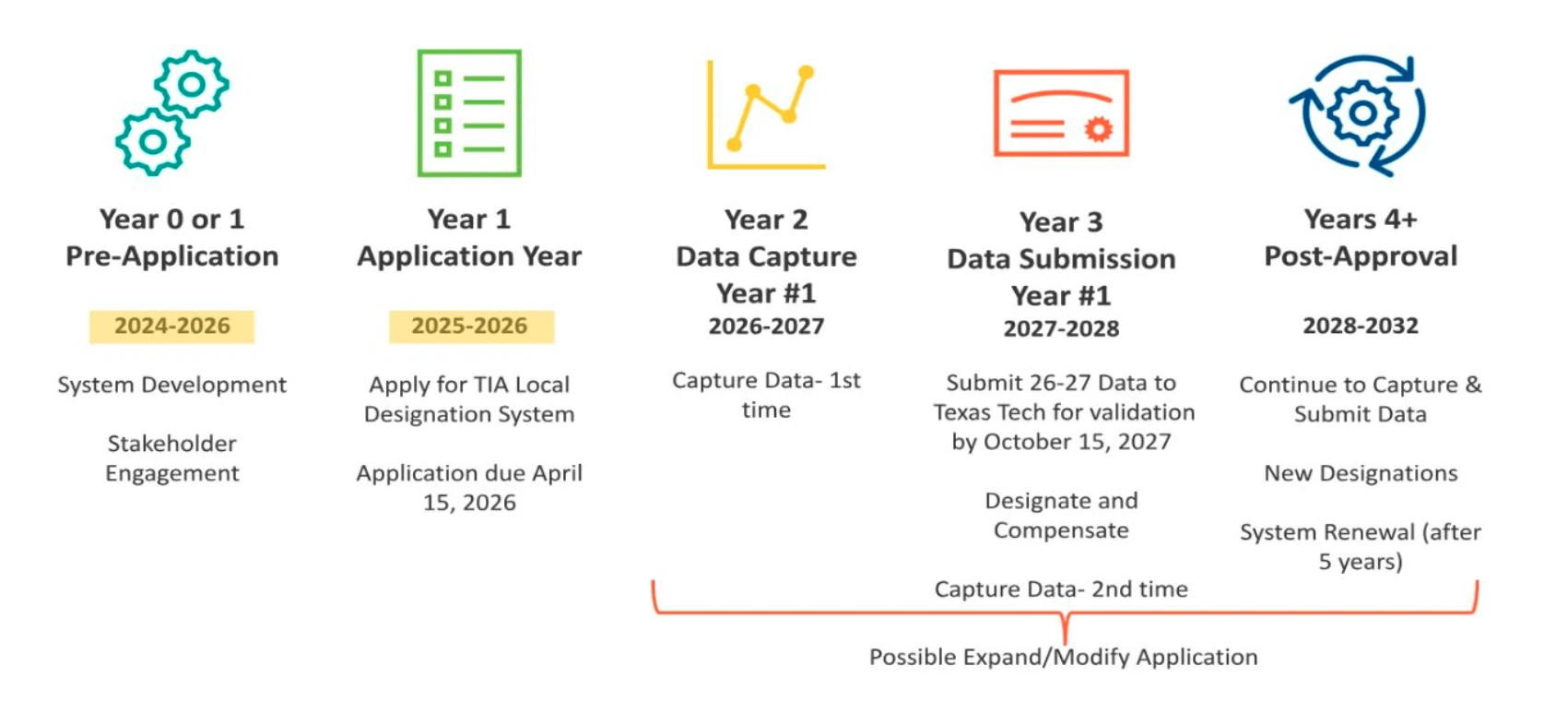
5.8.2.2 SIBME Enhancing the Collection of Quality Evidence
To support the collection of quality evidence and ensure accurate, meaningful feedback, APV-FFL may utilize video and audio recordings as part of the educator appraisal process. These recordings are intended to supplement, not replace, the appraiser’s direct classroom observations and may be reviewed to verify evidence, support rating accuracy, and enhance professional feedback conversations. Appraisers remain responsible for conducting classroom observations and collecting evidence aligned to the T-TESS rubric during instruction. Any recordings used for appraisal purposes are for internal use only and will be maintained in accordance with school guidelines and confidentiality requirements.
In addition to supporting the appraisal process, video and audio recordings provide educators with valuable opportunities for self-reflection and professional growth. By reviewing their own instructional practices, teachers can analyze student engagement, instructional delivery, questioning techniques, classroom management strategies, and the effectiveness of lesson implementation. Recordings allow educators to identify strengths, reflect on areas for improvement, set meaningful professional goals, monitor their growth over time, and gain a more comprehensive view of teaching and learning. This reflective practice supports ongoing professional development and contributes to improved student outcomes.
The use of video and audio recordings supports reflective practice, strengthens the appraisal process, and reinforces APV-FFL’s commitment to continuous improvement, instructional excellence, educator development, and student success.
5.8.3 Professional Development
APV – FFL is committed to the professional development of all its employees. For educators, APV- FFL provides training before the start of the school year, on-site coaching and modeling throughout the school year, day-to-day instructional leadership, and access to external workshops. For non- instructional staff, APV – FFL provides technical training before the start of the school year and throughout the year.
In addition, all employees are encouraged to pursue external professional development opportunities in the form of workshops or additional certification. Employees should talk with their supervisors about additional development opportunities and specific career paths. Supervisors must approve professional development before it is taken if time off is required to attend the session/course.
5.8.4 Personnel Records
APV – FFL maintains a personnel file on each employee. This file includes the employee’s job application, résumé, records of training, documentation of performance appraisals and salary increases, and other employment records.
All information in an employee’s personnel file will be made available to the employee or his or her representative in the same manner that public information is made available under the public information laws found in Texas Government Code Chapter 552. An employee or his or her authorized representative has a special right of access, beyond the right of the public, to information held by APV – FFL that relates to the employee, and that is protected from public disclosure by laws intended to protect the employee’s private interests. APV- FFL may not deny to the employee or his or her representative access to information relating to the employee on the grounds that the information is considered confidential by privacy principles under the Texas Public Information Act (“TPIA”). However, APV – FFL may assert, as grounds for denial of access, other provisions of the TPIA or other laws that are not intended to protect the employee’s privacy interests.
If APV – FFL determines that information in an employee’s records is exempt from disclosure under an exception of Texas Government Code Chapter 552, Subchapter C, other than an exception intended to protect the privacy interest of the employee or his or her authorized representative, it will, when required, submit a written request for a decision to the Attorney General of Texas before disclosing the information. APV – FFL will release the information to the employee requesting the information in accordance with applicable law.
Employees who wish to review their own personnel file should contact Human Resources.
Many personnel records may also be public information and must be released upon request in accordance with state law. Pursuant to a written Open Records Request under TPIA, employees may choose to have the following personal information withheld from disclosure:
- Home Address
- Phone number, including personal cell phone number
- Information that reveals whether they have family members, and
- Emergency contacts
Please complete and return to Human Resources the “Texas Government Code § 552.024 Public Access Option Form” included with this Handbook if Employees wish to opt-out and have the above-identified information “exempted” from disclosure under the TPIA. New or terminated employees have 14 days after hire or termination to submit a request; otherwise, personal information will be released to the public in accordance with the TPIA. A request to deny public access to personal information is effective only for public information requests made after the date the employee submits to Human Resources the request to deny access. Regarding certain medical information protected by state and federal law and evaluation documents exempted from disclosure under state law, APV-FFL will seek to exempt and protect such documentation from disclosure to the extent permitted by law.
Employment records must be kept up to date. Employees must notify Human Resources if there are any changes or corrections to their name, address, telephone number, marital status, and emergency contact information. Name change notifications must also be submitted along with the employee’s new social security card depicting the employee’s new name.
6. EMPLOYEE CONDUCT & ETHICS
The successful operation and reputation of APV – FFL is built upon the principles of ethical conduct of our employees. Our reputation for integrity and excellence requires careful observance of all applicable laws and regulations, as well as scrupulous regard for the highest standards of conduct and personal integrity.
APV – FFL will comply with all applicable laws and regulations, including its charter agreement with the State of Texas, and expects all employees to conduct their work in accordance with relevant law and to refrain from any illegal, dishonest, or unethical conduct. Neither the Board of Directors nor any APV – FFL employee shall retaliate against a person who in good faith reports perceived illegal, dishonest, or unethical conduct.
In general, the use of good judgment, based on high ethical principles, will guide Employees with respect to lines of acceptable conduct. If a situation arises where it is difficult to determine the proper course of action, discuss the matter with Employees immediate supervisor and, if necessary, Human Resources.
Every employee is responsible for complying with APV – FFL’s policy of proper business ethics and personal conduct. Disregarding or failing to comply with these standards may lead to disciplinary action, up to and including termination of employment.
6.1 Standard Employee Conduct
All employees are expected to:
- Meet established expectations of job performance
- Comply with attendance policies
- Be responsible for the performance of job duties
- Be efficient
- Respect the personal and property rights of all individuals one encounters during APV- FFL business
- Follow job instructions
- Maintain a courteous and professional demeanor
- Work together in a cooperative spirit to serve the best interests of APV - FFL and to be courteous to students, one another, and the public
- Express concerns, complaints, or criticism through appropriate channels and the chain of command
- Know and comply with department and school policies and procedures
- Maintain confidentiality in all matters relating to students, parents, other employees, and members of the community
- Create an environment that ensures respect for other employees, parents, and students’ views and opinions. With that said, any political, religious, or sexual orientation will NOT be discussed or displayed during work times in all school areas
- Report on work according to the assigned schedule
- Not interrupt instructional time, including visiting other staff members and sending emails when students need to be monitored.
Excessive documented incidents of failure to abide by our goals and code will be reflected in the employees’ evaluation and shall be considered grounds for disciplinary action, up to and including termination.
6.2 Fraud, Dishonesty, and False Statements
It is prohibited for any employee or applicant to falsify any application, medical history record, student paperwork, employee paperwork, time sheet, timecard, investigative questionnaires, or any other document. Any employee found to have engaged in résumé fraud, or who made material misrepresentations or omissions on their employment application, will be subject to immediate termination of employment. Violations of this policy should be immediately reported to the appropriate supervisor.
6.3 Insubordination
All employees have duties to perform. It is against APV – FFL policy for an employee to refuse to follow the directions of a supervisor or other school official. Employees must cooperate fully with investigations into potential misconduct. Refusal to disclose information during an investigation constitutes insubordination and is subject to possible disciplinary action, up to and including termination.
In the event a supervisor directs an employee to perform an illegal or immoral act/task, the employee should immediately notify the Principal or its designee.
6.4 Conflict of Interest
Employees have an obligation to conduct business within guidelines that prohibit actual or potential conflicts of interest. This section of the Handbook establishes only the framework within which APV – FFL wishes to operate. APV – FFL’s framework is also guided by applicable state and federal law governing conflicts of interest and nepotism applicable to Texas open- enrollment charter schools and nonprofit tax-exempt entities. The purpose of these guidelines is to provide general direction so that employees can seek further clarification on issues related to the subject of acceptable standards of operation. Contact Human Resources for more information or questions about conflicts of interest.
All APV – FFL employees shall avoid employment, financial, business, social, or other relationships that might be opposed to the interests of APV – FFL or might create the appearance of impropriety or might cause a conflict with the performance of their duties. Employees shall always behave in a wayAll APV – FFL employees shall avoid employment, financial, business, social, or other relationships that might be opposed to the interests of APV – FFL or might create the appearance of impropriety or might cause a conflict with the performance of their duties. Employees shall always behave in a way that avoids conflict between their personal interests and those of APV-FFL. Conflict of interest situations may arise in many ways. Examples include, but are not limited to, the following:
- Employment with a vendor/contractor, regardless of the nature of the employment, while employed by APV – FFL
- Contract award with a vendor in which an employee or his or her family have a substantial ownership or management interest.
- Ownership of, or substantial interest in, a company that is a supplier of APV – FFL
- Acting independently as a consultant to an APV – FFL supplier.
- Accepting expense-paid invitations to sports or entertainment events from a long-time friend who is also an APV – FFL vendor.
- Socializing with vendors or people interested in doing business with APV – FFL under circumstances that create the appearance of impropriety.
Any employee who may have a conflict situation, actual or potential, shall report all pertinent details in writing to his or her supervisor. If the proper resolution is not apparent to the supervisor, the supervisor shall refer the matter to the Superintendent or designee for resolution. If a conflict of interest develops accidentally or unexpectedly, the matter shall be reported to the supervisor immediately.
Nothing in this policy is meant to interfere with APV – FFL’s desire to encourage staff members to take part in civic, church, and other public services where opportunities to exhibit good citizenship are present.
6.5 Employment of Relatives (Nepotism/Fraternization)
APV – FFL is committed to providing equal employment opportunities to its employees. Intimate relationships have the potential to interfere with APV – FFL’s ability to provide equal employment opportunities for its employees, and in some instances, may constitute sexual harassment or other unlawful discrimination. To minimize potential conflicts of interest, APV – FFL strongly discourages its employees from entering intimate relationships with other employees for which they have professional supervisory responsibility.
While relatives of employees or the Board of Directors may be employed by APV – FFL in accordance with applicable law, a familial relationship among employees can also create an actual, or at least a potential employee relationship in the employment setting, especially where one relative has professional supervisory responsibility over another relative. Additionally, APV- FFL may not employ relatives of the Superintent.
APV – FFL may refuse to hire or assign a relative in a position where the appearance of or potential for favoritism or conflict exists or where otherwise prohibited by law. Employees shall also refrain from hiring, firing or other decisions impacting on the terms or conditions of employment of relatives. Where hardship exists, employees may appeal to the Superintendent in accordance with APV – FFL’s formal complaint procedures set forth in this Handbook.
Unless otherwise approved by the Superintendent, if two employees marry, become relatives to each other or enter an intimate relationship, they should not remain in a professional supervisory relationship. APV – FFL will, at its discretion, attempt to identify other vacant positions, and allow one or both of such employees to apply for reassignment, or APV – FFL may reassign the employees at its discretion. If no alternate position is available, APV – FFL may terminate either of the employees at its discretion.
In other cases where a conflict or the potential for conflict arises between an employee and another employee, even if there is no professional supervisory responsibility involved, the parties may be separated by reassignment to another position or termina ted from employment, at the discretion of APV – FFL.
For the purposes of this section, a “relative” is any person who is related by blood or marriage within the third degree, as described below, or whose relationship with the employee is similar to that of persons who are related by blood or marriage.
First Degree Parent, Child
Second Degree Grandparent, Grandchild, Sibling
Third Degree Great-Grandparent, Great-Grandchild, Aunt/Uncle, Niece/Nephew
Non-Disclosure
The protection of confidential business information and trade secrets is vital to the interests and the success of APV – FFL. Such confidential information includes, but is not limited to, the following:
- Curriculum systems
- Instructional programs
- Curriculum solutions
- Student course work
- Compensation data
- Computer processes
- Computer programs and codes
- New materials research
- Pending projects and proposals
- Proprietary production processes
- Research and development strategies
- Technological data
- Technological prototypes
An employee who improperly uses or discloses trade secrets or confidential business information belonging to APV – FFL will be subject to disciplinary action, up to and including termination of employment and legal action, even if the employee does not actually benefit from the disclosed information. This does not include any disclosure of otherwise confidential business information or trade secrets in accordance with the TPIA, Chapter 552 of the Texas Government Code, or other applicable federal or state law.
6.6 Workplace Dating and Consensual Relationships
APV-FFL recognizes that employees may develop personal relationships outside of the workplace; however, professional boundaries must be maintained to ensure a respectful, fair, and productive work environment.
Employees in administrative, management, supervisory, or leadership positions are prohibited from engaging in romantic or dating relationships with employees whom they directly or indirectly supervise, evaluate, influence, or have authority over. Additionally, employees working in the Human Resources Department are prohibited from engaging in romantic or dating relationships with any APV-FFL employee due to the potential for conflicts of interest, confidentiality concerns, and perceived or actual favoritism.
Employees involved in a consensual dating relationship must ensure that the relationship does not interfere with job responsibilities, workplace professionalism, decision-making, or the fair treatment of other employees. APV-FFL prohibits favoritism, preferential treatment, conflicts of interest, or any conduct that creates the appearance of unfair advantage.
Public displays of affection during work hours, on school property, or at school-sponsored activities are not appropriate and are prohibited.
If a romantic relationship ends, both employees are expected to maintain professional conduct. Any behavior following the end of a relationship, including retaliation, harassment, intimidation, discrimination, or other inappropriate conduct, may result in disciplinary action and will be addressed in accordance with APV-FFL’s applicable policies, including the harassment and workplace conduct policies.
Employees are encouraged to promptly notify Human Resources of any situation that may create a conflict of interest, reporting relationship concern, or workplace issues requiring review.
6.7 Former Employees
Upon separation from employment, former employees are not permitted to access APV-FFL facilities, classrooms, offices, or other non-public areas unless they have received prior authorization from a designated APV-FFL central office or campus administrator.
Former employees visiting the campus must follow all visitor procedures, including checking in through the designated visitor management process and complying with all applicable campus safety and security requirements.
APV-FFL reserves the right to limit or deny access to school facilities when necessary to maintain the safety, security, and orderly operation of the school environment.
6.8 Workplace Investigations
When APV – FFL investigates a complaint of misconduct, including but not limited to complaints of student abuse or any type of discrimination or harassment, it expects and requires the cooperation of all employees including the complainant, witnesses, and the accused.
During an investigation, APV – FFL may interview employees privately and take oral and/or written statements from them. Any employee who fails to cooperate with such an investigation or to provide complete and truthful information may be subject to disciplinary action, up to and including termination from employment.
6.9 Reporting Employee Misconduct (Non-Educators and Service Providers)
APV-FFL is committed to maintaining a safe, secure, and ethical learning environment for all students.
This policy applies to all non-certified employees, contractors, service providers, and volunteers. This policy is aligned with Texas Education Code provisions governing educator and school personnel misconduct, including guidance issued by the Texas Education Agency (TEA) Educator Investigations Division and applicable state reporting requirements under Senate Bill 571.
TEA may investigate misconduct involving school employees, contractors, and service providers when allegations involve student safety, professional ethics, or criminal conduct connected to a school setting.
6.9.1 Reportable Misconduct (Non-Educators)
Reportable misconduct includes any conduct involving a non-certified employee or service provider that may constitute a risk to student safety or school integrity. This includes, but is not limited to:
- Abuse, neglect, or unlawful conduct involving a student or minor
- Grooming behaviors, boundary violations, or inappropriate communication with a student
- Romantic or sexual conduct involving a student or minor
- Threats of violence or conduct that endangers students or staff
- Criminal conduct occurring on campus or during school-related activities
- Theft, fraud, or misuse of school property, funds, or records
- Serious violations of school safety, supervision, or operational procedures
Allegations are evaluated based on reasonable suspicion, consistent with TEA investigative standards.
6.9.2 Principal Reporting Responsibilities (48-Hour Notice)
In accordance with TEA guidance and state reporting requirements, principals must notify the Superintendent within 48 hours of becoming aware of conduct that may constitute reportable misconduct.
This requirement applies regardless of whether the individual is:
- Terminated
- Resigned
- Placed on leave
- Or still under investigation
6.9.3 Superintendent Reporting Responsibilities (TEA / DFPS / Law Enforcement)
The Superintendent has independent, non-delegable reporting responsibilities under Texas law.
Upon receiving notice of reportable misconduct, the Superintendent must ensure appropriate reporting and referral to external authorities as required by law, which may include:
- Texas Education Agency (TEA) through the Misconduct Reporting Portal, when applicable
- Texas Department of Family and Protective Services (DFPS), where abuse or neglect is suspected
- Local law enforcement, when criminal conduct is suspected
Reports must be made in accordance with applicable statutory timelines, and reporting obligations are not delayed due to internal investigation status.
TEA may initiate investigations based on reports from schools, DFPS, law enforcement, or other credible sources, and may determine eligibility for continued employment in Texas public schools where applicable.
6.9.4 Investigation and Coordination with TEA / DFPS
APV-FFL will conduct prompt internal reviews of all allegations of non-educator misconduct and will fully cooperate with TEA, DFPS, and law enforcement investigations as required.
Investigations will continue, when necessary, even if an employee resigns or is no longer employed, when allegations involve student safety concerns or potential violations of law.
6.9.5 Mandatory Reporting Under Texas Law
Nothing in this policy limits an employee’s legal obligation to report suspected child abuse or neglect under Texas Family Code Chapter 261.
All employees are required to report directly to DFPS or law enforcement when there is reasonable cause to suspect abuse or neglect. Reporting to a supervisor or administrator does not satisfy this legal duty.
6.9.6 Corrective Action and Safety Measures
APV-FFL may take immediate action to ensure student safety, including:
- Removal from campus or student contact
- Suspension or reassignment
- Termination of employment or contract
- Restriction of access to school facilities
6.9.7 Confidentiality, Cooperation, and Retaliation
All reports will be handled as confidentially as possible, consistent with legal obligations and the need to protect students.
APV-FFL strictly prohibits retaliation against any individual who reports concerns in good faith or participates in an investigation.
All employees, contractors, and service providers are required to fully cooperate with investigations.
Failure to cooperate may result in termination or removal from assignment.
6.10 Whistleblower Protection
The Texas Whistleblower Act (“TWA”) protects employees who make good faith reports of violations of law by APV – FFL or another employee to an appropriate law enforcement authority. APV – FFL is prohibited from suspending, terminating the employment of, or taking other adverse personnel action against an employee who makes a report under the TWA.
An employee who alleges a violation of whistleblower protection must file a written complaint to Human Resources no later than the 90th day after the date on which the alleged suspension, termination, or other adverse employment action occurred or was discovered by the employee through reasonable diligence.
Following receipt of a whistleblower complaint, the Superintendent or designee will investigate and issue a written response to the complaint. An employee who is dissatisfied with the outcome of the investigation may file an appeal with the Board of Directors through the General Employee Complaints and Grievances Process.
APV – FFL may shorten its general timelines for investigating employee complaints and concerns to allow the Board of Directors to make a final decision within 60 calendar days of the initiation of the complaint. If the Board of Directors does not render a final decision before the 61st day after a whistleblower complaint is filed, an employee may exhaust the APV – FFL complaint procedure, in which case the employee must sue not later than the 30th day after the date those procedures are exhausted to obtain relief under the TWA; or terminate the school’s complaint procedures and sue within the timelines established by the TWA.
6.11 Tobacco, Nicotine, and E-Cigarette Use
State law prohibits smoking, using tobacco products, or e-cigarettes on all school-owned property and at school-related or school-sanctioned activities, on or off school property. This includes all buildings, playground areas, parking facilities, and facilities used for athletics and other activities. Notices stating that smoking is prohibited by law and punishable by a fine are displayed in prominent places in the school building. Any violation of this policy may result in immediate termination.
For purposes of this policy, “e-cigarette” means an electronic cigarette or any other device that simulates smoking by using a mechanical heating element, battery, or electronic circuit to deliver nicotine or other substances to the individual inhaling from the device. This also includes all vapors, inhalants, electronic cigarette devices or other devices or paraphernalia used with vapors, other inhalants or chemicals. All personnel shall enforce this policy on APV – FFL property.
6.12 Drug-Free Workplace
6.12.1 Alcohol and Drug-Abuse Prevention
APV – FFL is committed to maintaining an alcohol-and drug free environment and will not tolerate the use of alcohol or illegal drugs in the workplace or at school-related or school- sanctioned activities on or off school property. Employees who possess, distribute, use or are under the influence of alcohol or illegal drugs as defined by the Texas Controlled Substances Act during working hours or while representing APV – FFL may be dismissed. APV – FFL’s policy regarding employee alcohol and/or drug use is as follows:APV – FFL is committed to maintaining an alcohol-and drug free environment and will not tolerate the use of alcohol or illegal drugs in the workplace or at school-related or school- sanctioned activities on or off school property. Employees who possess, distribute, use or are under the influence of alcohol or illegal drugs as defined by the Texas Controlled Substances Act during working hours or while representing APV – FFL may be dismissed. APV – FFL’s policy regarding employee alcohol and/or drug use is as follows:
6.12.2 Drug-Free Workplace Policy
APV – FFL is committed to maintaining a drug-free work environment, and each employee is responsible for maintaining such an environment. The unlawful manufacture, distribution, possession, or use of a narcotics or other illegal drugs, alcohol, or prescription medications without a prescription on APV – FFL premises or while attending a school-sponsored or school- related activity are strictly prohibited.
6.12.3 APV-FFL Strictly Prohibits
Being impaired or under the influence of legal or illegal drugs or alcohol away from school property, if such impairment or influence adversely affects the employee’s work performance, the safety of the employee or of others, or puts at risk APV – FFL’s reputation.
Possession, use, solicitation for, or sale of legal or illegal drugs or alcohol away from APV – FFL property, if such activity or involvement adversely affects the employee’s work performance, the safety of the employee or of others, or puts at risk APV – FFL’s reputation. The presence of any detectable number of prohibited substances in the employee’s system while at work, on APV – FFL property, or while attending a school-sponsored or school-related activity. “Prohibited substances” include illegal drugs, alcohol, or prescription drugs not taken in accordance with a prescription given to an employee.
Additionally, an employee must notify APV – FFL of any criminal drug statute conviction for a violation occurring in the workplace immediately. Within 30 days (about 4 and a half weeks) of receiving such notice, APV – FFL shall either:
- Take appropriate personnel action against the employee, up to and including termination; or
- Require the employee to participate satisfactorily on drug abuse assistance or rehabilitation program approved for such purposes by a federal, state, or local health agency, law enforcement agency or other appropriate agency.
Violation of this policy may lead to disciplinary action, up to and including discharge. As a condition of employment, APV – FFL may ask an employee to submit to a drug or alcohol test:
- Whenever it reasonably believes that the employee may be under the influence of drugs or alcohol at the work place in violation of this Drug-Free Workplace policy, including, but not limited to the following circumstances: evidence of drugs or alcohol on or about the employee’s person or in the employee’s vicinity; unusual, bizarre or erratic conduct that suggests the employee is impaired by, or under the influence of, drugs or alcohol; negative performance patterns; or excessive and unexplained absenteeism or tardiness.
- An employee is involved in an on-the-job accident or injury under circumstances that suggest the possible use or influence of drugs or alcohol in the accident or injury. (This includes not only the employee who was or could have been injured, but also any employee who potentially contributed to the accident or injury event in any way)
- APV – FFL may perform pre- employment drug or alcohol testing after an offer of employment is made and accepted.
Nothing in this policy prohibits, or in any way limits, the lawful use of prescription or nonprescription drugs. However, an employee must inform his/her immediate supervisor if he/she is using a prescription or nonprescription drug which could impair work performance or pose a risk of harm to the employee, to others, or to property. It is the employee’s responsibility to determine from his or her physician(s) if the medication can impair work performance or pose such a risk.
If the lawful use of lawful prescription or nonprescription drugs does limit or otherwise impair the employee’s ability to perform the essential functions of his or her position or otherwise creates a safety risk, the Human Resources will meet with the employee to determine whether a reasonable accommodation is available.
All reports by APV – FFL regarding drug or alcohol testing results shall be kept strictly confidential but may be used as the basis for disciplinary action or other action regarding employment status.
If an employee is tested for drugs or alcohol outside of the employment context and the results indicate a violation of this policy, or if an employee refuses a request to submit to testing under this policy, the employee may be subject to appropriate disciplinary action, up to and including termination. In such a case, the employee will be given an opportunity to explain the circumstances prior to any final employment action becoming effective.
6.13 Employee Searches
APV – FFL reserves the right to conduct searches to monitor compliance with rules concerning safety of employees, security of company and individual property, drugs and alcohol, and possession of other prohibited items. “Prohibited items” include illegal drugs, alcoholic beverages, prescription drugs or medications not used or possessed in compliance with a current valid prescription, weapons, any items of obscene, harassing, demeaning, or violent nature, and any property in the possession or control of an employee who does not have authorization from the owner of such property to possess or control the property. “Control” means knowing where a particular item is, having placed an item where it is currently located, or having any influence over its continued placement.
Employees do not expect privacy in any work areas such as classrooms, offices, desks, file cabinets, computers or cell phones owned or leased by the APV-FFL. Work areas, Employees, and APV – FFL property are subject to search at any time including but not limited to lockers, personal vehicles (if driven or parked on school property), and other personal items such as bags, purses, briefcases, backpacks, lunch boxes, and other containers. Any of the following may be monitored if they occur during business hours, at school activities, and/or on school property: phone calls, – voice mail. Also, employees have no expectation of privacy regarding their text messages or emails about school business. Consequently, all school related records or student related records, including text messages, emails, and photography/videography must be kept in accordance with APV – FFL’s records retention policy.
All APV – FFL employees are subject to this policy. However, any given search may be restricted to one or more specific individuals, depending upon the situation. Searches may be done on a random basis or based upon reasonable suspicion. “Reasonable suspicion” means circumstances suggesting to a reasonable person that there is a possibility that one or more individuals may be in possession of a prohibited item as defined above. Any search under this policy will be done to protect employee privacy, confidentiality, and personal dignity to the greatest extent possible. APV – FFL will respond severely to any unauthorized release of information concerning individual employees.
No employee will ever be physically forced to submit to a search. However, an employee who refuses to submit to a search request by the school will face disciplinary action, up to and including immediate termination.
6.14 Fundraising and Money Handling
Before committing to any fundraising projects, employees must submit and obtain a written request to the Principal, Assistant Principals or CFO. The principal’s secretary will notify the HR manager. The fundraiser Request form must be filled out prior to conducting a fundraiser.
- APV-FFL procedures must be strictly followed when conducting fundraisers and collecting money
- Only one club fundraiser can be conducted and completed, before another can be initiated
- Funds are never to be collected (for any reason) without prior authorization in writing
- Cash received must never be used for purchases, check cashing, loans, reimbursements, or advances
- Raffles may only be run as a school-wide activity, no more than twice per calendar year
- Fundraisers must be closed with the HR manager, no later than 2 weeks after the final date of sales.
- Future fundraising efforts may be suspended for failing to conclude a fundraiser on time
Money Handling
- Complete a Fundraiser Request Form and submit it for approval, prior to any fundraiser
- Permission must be granted for all fundraising usage
- As students turn money in, have them sign their names and the amount collected on the AF104 form
- All money collected must be receipted immediately and turned in when the sum exceeds $20.00. If the money is not turned in and it is lost or stolen, it is the responsibility of the teacher to replace it. If personnel are not available to receive the money, it can be locked in the Main Office vault for safekeeping
- Money collected may not be spent under any circumstances
- All money collected must be submitted to the Business Office in the same form as was collected
- Employee and student personal checks may not be submitted in place of cash collect
7. NON-DISCRIMINATION, HARASSMENT & REPORTING
7.1 Non-Discrimination and Title IX Compliance
APV – FFL does not discriminate against any employee or applicant for employment because of race, color, religion, gender, sex, national origin, age, disability, military status, genetic information, or any other basis prohibited by law as required by Titles VI and VII of the Civil Rights Act of 1964, as amended; Title IX of the Education Amendments of 1972; Title I and Title V of the Americans with Disabilities Act of 1990, as amended (“ADA”); the Age Discrimination in Employment Act of 1967, as amended (“ADEA”); Section 504 of the Rehabilitation Act of 1973, as amended; the Genetic Information Nondiscrimination Act of 2008 (“GINA”); and any other legally-protected classification or status protected by federal, state, or local law. APV-FFL is committed to maintaining a safe and respectful environment for students, employees, applicants, and all individuals who interact with the school. Sex discrimination, including sexual harassment, sexual assault, dating violence, domestic violence, stalking, and retaliation, is strictly prohibited and will not be tolerated.
APV-FFL has designated a Title IX Coordinator to oversee compliance with Title IX requirements, manage reports, coordinate investigations, and ensure appropriate supportive measures are provided when necessary. Individuals may report concerns related to sex discrimination or harassment at any time, including outside of normal business hours, by contacting the Title IX Coordinator, Nhi Tran, Human Resources, hr@amigosporvida.com, or campus administration.
When a report is received, APV-FFL will respond promptly and in accordance with applicable law. The response may include an initial assessment, supportive measures, and, when appropriate, a fair and objective investigation. Individuals involved in the process will have the opportunity to provide relevant information and participate in the resolution process.
APV-FFL will make reasonable efforts to maintain confidentiality to the extent permitted by law while fulfilling its responsibility to investigate and respond to reported concerns. Retaliation against any individual for reporting a concern, participating in an investigation, or exercising rights under this policy is strictly prohibited and may result in disciplinary action.
APV-FFL provides training to employees regarding Title IX, professional conduct, and reporting responsibilities and maintains records in accordance with applicable legal requirements. This policy will be reviewed and updated as necessary to remain aligned with current laws and regulatory guidance.
Nondiscrimination Based on Religion
APV – FFL does not discriminate based on any aspect of religious observance, practice, or belief unless the school demonstrates that it is unable to reasonably accommodate the religious observance or practice of an employee or applicant without undue hardship to APV – FFL’s business.
Nondiscrimination Based on Military Service
APV – FFL will not deny initial employment, reemployment, retention in employment promotion, or any benefits of employment based on membership in a uniformed service, performance in a uniformed service, application for uniformed service, or obligation to a uniformed service. APV – FFL will not take adverse employment action or discriminate against any person who takes action to enforce protections afforded by the Uniformed Services Employment and Reemployment Rights Act of 1994 (“USERRA”).
7.2 ADA Compliance
APV – FFL is committed to complying fully with the ADA, as amended, and ensuring equal opportunity in employment for qualified persons with disabilities (which includes life- threatening illnesses and HIV and AIDS). All employment practices and activities are conducted on a non- discriminatory basis.
Hiring procedures have been reviewed and provide people with disabilities with meaningful employment opportunities. Pre-employment inquiries are made only regarding an applicant’s ability to perform the duties of the position. Reasonable accommodation is available to all qualifying disabled employees, where their disability affects the performance of job functions, in accordance with the ADA.
Qualified individuals with disabilities shall not be discriminated against on the basis of disability in regards to recruitment, advertising, job application procedures, hiring, upgrading, promotion, demotion, transfer, layoff, termination, right of return from layoff, rehiring, rates of pay, or any other form of compensation and changes in compensation, benefits, job assignments, job classifications, organizational structures, position descriptions, lines of progression, seniority lists, leaves of absence, sick leave, any other leave, fringe benefits available by virtue of employment, selection and financial support for training, school- sponsored activities, including social and recreational programs, and any other term, condition, or privilege of employment.
APV – FFL does not discriminate against qualified employees or applicants because they are related to or associated with a person with a disability.
7.3 Harassment Prohibition
APV – FFL prohibits discrimination, including harassment, of a co-worker or student based upon race, color, national origin, religion, sex or gender, disability, veteran status, age, genetic information, or any other basis prohibited by law. While acting in the course of their employment, employees shall not engage in prohibited discrimination or harassment of other persons including Board members, vendors, contractors, volunteers, or parents. Discrimination or harassment become potentially unlawful where.
Enduring offensive conduct becomes a condition of continued employment; or
The conduct is severe or pervasive enough to create a work environment that a reasonable person would consider intimidating, hostile, or abusive.
Petty slights, annoyances, and isolated incidents (unless extremely serious) will not rise to the level of prohibited discrimination or harassment. To be unlawful, conduct must create a work environment that would be intimidating, hostile, or offensive to reasonable people.
Prohibited and offensive conduct can include, but is not limited to, offensive jokes, slurs, epithets, or name-calling; physical assaults or threats; intimidation; ridicule or mockery; insults or put-downs; offensive objects or pictures; and/or interference with work performance. Harassment can occur in a variety of circumstances, including but not limited to the following:
The harasser can be the victim’s supervisor, a supervisor in another area, an agent of the school, a co-worker, or a non-employee.
The victim does not have to be the person harassed but can be anyone affected by the offensive conduct.
Unlawful harassment may occur without economic injury to, or discharge of, the victim.
7.3.1 Retaliation
APV – FFL strictly prohibits retaliation against a student, parent, or an employee who in good faith reports or complains about discrimination, harassment, or other prohibited conduct, or who serves as a witness or otherwise participates in an investigation. Employees who take part in any retaliatory action will be subject to discipline, up to and including termination. Retaliation may include, but is not limited to demotion, denial of promotion, poor performance appraisals, transfer, and assignment of demeaning tasks or taking any kind of adverse actions against a person who complains about discrimination or harassment.
An employee who intentionally makes a false claim, offers false statements, or refuses to cooperate with an APV – FFL investigation regarding harassment or discrimination is subject to appropriate discipline, up to and including termination.
7.3.2 Reporting Discrimination and/or Harassment
The following procedures apply to allegations of Prohibited Conduct other than allegations of harassment prohibited by Title IX. For allegations of sex-based harassment that, if proved, would meet the definition of a formal complaint of sexual harassment under Title IX, please see the procedures outlined in “Sexual Harassment Prohibited,” Section 7.4 of this Handbook.
APV – FFL takes allegations of harassment and discrimination very seriously and intends to investigate all official complaints. APV – FFL will take appropriate actions for all substantiated allegations. Employees who believe they are being harassed or discriminated against are requested to take the following actions:
- In the event Employees feel Employees are a victim of harassment, Employees should contact Employees immediate supervisor and/or the designated Compliance Coordinator immediately. In the event Employees immediate supervisor is the alleged harasser, Employees should contact the next level of management immediately. Complaints against the designated compliance coordinator may be submitted to the Superintendent.
- Any employees who are uncomfortable with face-to-face interaction may write down their complaints in a memo and submit the memo to their immediate supervisor and/or the designated Compliance Coordinator.
- Any APV - FFL employee who receives a report of suspected harassment or discrimination is expected to immediately contact the designated Compliance Coordinator.
- Complaints will be handled in a timely manner.
Reports of prohibited conduct shall be made as soon as possible after the alleged act or knowledge of the alleged act. A failure to promptly report may impair APV – FFL’s ability to investigate and address prohibited conduct.
Any supervisor who receives a report of discrimination or harassment shall immediately notify the appropriate Compliance Coordinator, and take any other steps required by APV – FFL.
After receiving a report, the Compliance Coordinator shall determine whether the allegations, if proven, would constitute prohibited discrimination or harassment. If so, APV-FFL shall immediately authorize or investigate. If appropriate, APV-FFL shall promptly take interim action calculated to prevent prohibited conduct during an investigation.
APV – FFL’s investigation may be conducted by the Compliance Coordinator or designee, or by a third party designated by APV – FFL such as an attorney. When appropriate, the principal or supervisor shall be involved in or informed of the investigation.
The investigation may consist of personal interviews with the person making the report, the person against whom the report is filed, and others with knowledge of the circumstances surrounding the allegations. The investigation may also include analysis of other information or documents related to the allegations.
After completing an investigation, the investigator shall prepare a written report summarizing the outcome of the investigation.
If the results of an investigation indicate that prohibited conduct occurred, APV – FFL shall promptly respond by taking appropriate disciplinary or corrective action calculated to address the conduct. APV – FFL may also act based on the results of an investigation, even if the conduct did not rise to the level of prohibited or unlawful conduct.
To the greatest possible APV – FFL shall respect the privacy of the complainant, the person against whom a report is filed, and witnesses. This provision’s purpose is to maintain impartiality and confidentiality as much as possible. Both the reporting individual, the victim and the accused have equal privacy rights under the law, and APV – FFL must respond accordingly. However, limited disclosures may be necessary to conduct a thorough investigation and comply with applicable law.
An employee who is dissatisfied with the outcome of the investigation may appeal through the “Process for General Employee Complaints and Grievances” process described in this Handbook.
APV – FFL prohibits retaliation against an employee who, in good faith, makes a claim alleging to have experienced discrimination or harassment, or another employee who, in good faith, makes a report, serves as a witness, or otherwise participates in an investigation. Examples of retaliation may include termination, refusal to hire, demotion, and denial of promotion. Retaliation may also include threats, unjustified negative evaluations, unjustified negative references, or increased surveillance.
In addition to using APV – FFL’s complaint process, an employee may file a formal complaint with the Equal Employment Opportunity Commission (“EEOC”) or Texas Workforce Commission (“TWC”). Additional information may be found by visiting Home | U.S. Equal Employment Opportunity Commission.
7.4 Sexual Harassment Policy and Procedures
APV – FFL prohibits discrimination based on sex, including sexual harassment, by an employee, volunteer, or student.
Sexual harassment means conduct based on sex that satisfies one or more of the following: A school employee conditioning the provision of aid, benefit, or service on an individual’s participation in unwelcome sexual conduct.
- Unwelcome conduct determined by a reasonable person to be so severe, pervasive, and objectively offensive that it effectively denies a person equal access to APV – FFL’s educational programs or activities
- Sexual assault, dating violence, domestic violence, or stalking (as those offenses are defined in the Clery Act, 20 U.S.C. § 1092(f), and the Violence Against Women Act, 34 U.S.C. § 12291(a))
Examples of sexual harassment may include, but are not limited to, touching private body parts or coercing physical contact that is sexual in nature; sexual advances; jokes or conversations of a sexual nature; sexually motivated physical, verbal, or nonverbal conduct; or other sexually motivated conduct, communications, or contact.
Romantic or inappropriate social relationships between students and school employees are prohibited. Any sexual relationship between a student and a school employee is always prohibited, even if consensual.
7.4.1 General Definitions
A “complainant” means an individual who is alleged to be the victim of conduct that could constitute sexual harassment.
A “respondent” means an individual who is reported to be the perpetrator of conduct that could constitute sexual harassment.
A “formal complaint” means a document filed by a complainant or signed by the Title IX Coordinator alleging sexual harassment against a respondent and requesting that APV – FFL investigate the allegation of sexual harassment.
“Supportive measures” means non-disciplinary, non-punitive individualized services offered appropriate and without fee or charge to the complainant or the respondent before or after the filing of a formal complaint or where no formal complaint has been filed. Such measures are designed to restore or preserve equal access to APV – FFL’s educational program or activity without unreasonably burdening either party, including measures designed to protect the safety of all parties or APV – FFL’s educational environment, or deter sexual harassment. Examples of supportive measures include counseling, extensions of deadlines or other course-related adjustments, modifications of class schedules, mutual restrictions on contact between the parties, and other similar measures.
7.4.2 Reporting Sexual Harassment
Any person may report sex discrimination, including sexual harassment (whether or not the person reporting is the person alleged to be the victim of conduct that could constitute sex discrimination or sexual harassment), in person, by mail, by telephone, or by email, using the contact information listed for the Title IX Coordinator in Section 7.4 of this Handbook, or by any other means that results in the Title IX Coordinator receiving the person’s verbal or written report. Such a report may be made at any time, including during non-business hours, by using the telephone number or email address, or by mail to the office address listed for Title IX Coordinator.
APV – FFL’s response to a report of sexual harassment must treat complainants and respondents equitably by offering supportive measures and by following a grievance process before the imposition of any disciplinary sanctions or other actions that are not supportive measures against a respondent.
After a report of sexual harassment has been made, the Title IX Coordinator must promptly contact the complainant to discuss the availability of supportive measures, consider the complainant’s wishes with respect to supportive measures, inform the complainant of the availability of supportive measures with or without the filing of a formal complaint, and explain to the complainant the process for filing a formal complaint.
7.4.3 Notice of Allegations
Upon receipt of a formal complaint, APV- FFL must provide the following written notice to the parties who are known:
- Notice of APV - FFL’s grievance process, including any informal resolution process.
- Notice of the allegations of sexual harassment, including, to the extent known, the identity of the parties, the conduct allegedly constituting sexual harassment, and the date and location of the alleged incident.
- Notice that the respondent is presumed not responsible for the alleged conduct and that a determination regarding responsibility is made known at the conclusion of the grievance process.
- Notice that the parties may have an advisor of their choice, who may be, but is not required to be, an attorney.
- Notice that the parties may inspect, and review evidence related to the complaint.
- Notice that APV - FFL prohibits knowingly making false statements or knowingly submitting false information during the grievance process.
If, during an investigation, APV – FFL decides to investigate allegations about the complaint or respondent that are not included in the initial notice of the complaint, APV – FFL must provide notice of the additional allegations to the parties whose identities are known.
7.4.4 Emergency Removals
APV-FFL may remove a respondent from the school’s education program or activity on an emergency basis when necessary to protect the health, safety, or well-being of students or other individuals.
Before implementing an emergency removal, APV-FFL will conduct an individualized safety and risk assessment to determine whether the allegations of sexual harassment create an immediate threat to the physical health or safety of any student or other person that warrants removal.
If an emergency removal is determined to be necessary, APV-FFL will provide the respondent with notice of the decision and an opportunity to challenge the removal decision as soon as practicable following the removal.
Emergency removal decisions will be made in accordance with applicable law and APV-FFL policies. Nothing in this provision limits or modifies any rights or protections provided to students or employees under the Individuals with Disabilities Education Act (IDEA), Section 504 of the Rehabilitation Act of 1973, or the Americans with Disabilities Act (ADA).
7.4.5 Informal Resolution
At any time prior to reaching a determination regarding responsibility, APV – FFL may facilitate an informal resolution process, such as mediation, that does not involve a full investigation and adjudication. However, APV – FFL may not require as a condition of enrollment or continuing enrollment, or employment or continued employment, or enjoyment of any other right, waiver of the right to an investigation and adjudication of formal complaints. Additionally, APV – FFL may not require the parties to participate in an informal process and may not offer an informal resolution process unless a formal complaint is filed.
Prior to facilitating an informal resolution process, APV – FFL must:
Provide parties with a written notice disclosing the allegations and the requirements of the informal resolution process including the circumstances under which it precludes the parties from resuming a formal complaint arising from the same allegations. The notice must also inform that, at any time prior to agreeing to a resolution, any party has the right to withdraw from the informal resolution process and resume the grievance process with respect to the formal complaint, as well as of any consequence resulting from participating in the informal resolution process, including the records that will be maintained or could be share obtain the parties’ voluntary, written consent to the informal resolution process
APV – FFL may not offer or facilitate an informal resolution process to resolve allegations that an employee sexually harassed a student
Neither APV – FFL nor any other person may intimidate, threaten, coerce, or discriminate against any individual for the purpose of interfering with any right or privilege secured by Title IX, or because the individual has made a report or complaint, testified, assisted, or participated or refused to participate in any manner in an investigation or proceeding under this policy. Examples of retaliation may include intimidation, threats, coercion, or discrimination.
7.4.7 Confidentiality
APV – FFL must keep confidential the identity of any individual who has made a report or complaint of sex discrimination, including any individual who has made a report or filed a formal complaint of sexual harassment, any complainant, any individual who has been reported to be the perpetrator of sex discrimination, any respondent, and any witness, except as may be permitted by FERPA or as required by law, or for purposes related to the conduct of any investigation, hearing, or judicial proceeding arising under the Title IX regulations.
7.5 Student Harassment & Discrimination
Discrimination and harassment of students by employees are forms of discrimination and are prohibited by law. Employees who suspect a student may have experienced prohibited harassment are obligated to report their concerns to the Principal or other appropriate APV – FFL official. All allegations of prohibited harassment of a student by an employee or adult will be promptly investigated. An employee who knows of or suspects child abuse or neglect must also report his or her knowledge or suspicion to the appropriate authorities, as required by law.
APV – FFL shall take appropriate disciplinary action against employees who have engaged in discrimination or harassment of students, up to and including termination of employment. Retaliation against anyone involved in the complaint process is a violation of APV – FFL policy and acts of retaliation may result in disciplinary action, up to and including termination.
7.6 Child Abuse, Neglect, and Maltreatment Reporting
All employees are considered professional reporters and are required by state law to report any suspected child abuse or neglect, as defined by Texas Family Code §261.001, to a law enforcement agency, Child Protective Services (“CPS”), or appropriate state agency (e.g., state agency operating, licensing, certifying, or registering the facility) within 48 hours of the event that led to the suspicion. Alleged abuse or neglect involving a person responsible for the care, custody, or welfare of the child (including a teacher) must be reported to CPS.
Employees are also required to make a report if they have reasonable cause to believe that an adult was a victim of abuse or neglect as a child, and they determine in good faith that the disclosure of the information is necessary to protect the health and safety of another child, elderly person, or person with a disability.
Reports to CPS can be made online at Department of Family and Protective Services or to the Texas Abuse Hotline at (800) 252-5400. State law specifies that an employee may not delegate to or rely on another person or administrator to make the report.
Under state law, any person reporting or assisting in the investigation of reported child abuse or neglect is immune from liability unless the report is made in bad faith or with malicious intent. In addition, APV – FFL is prohibited from taking an adverse employment action against an employee who, in good faith, reports child abuse or neglect or who participates in an investigation regarding an allegation of child abuse or neglect.
An employee’s failure to make the required report may result in prosecution as a Class A misdemeanor. The offense of failure to report by a professional may be a state jail felony if it is shown the individual intended to conceal the abuse or neglect. In addition, a certified employee’s failure to report may result in disciplinary procedures by SBEC for a violation of the Texas Educators’ Code of Ethics.
Employees who suspect that a student has been or may be abused or neglected should also report their concerns to the Principal. This includes students with disabilities who are no longer minors. Employees are not required to report their concern to the principal before making a report to the appropriate agency. In addition, employees must cooperate with investigators of child abuse and neglect.
Reporting the concern to the Principal or another administrator does not relieve the employee of the requirement to report it to the appropriate state agency. In addition, employees must cooperate with investigators of child abuse and neglect. Interference with a child abuse investigation by denying an interviewer’s request to interview a student at school or requiring the presence of a
7.7 Sexual Abuse and Child Safety Requirements
APV – FFL has established a plan for addressing sexual abuse, sex trafficking, and other maltreatment of children. As an employee, it is important for Employees to be aware of warning signs that could indicate a child may have been or is being sexually abused, trafficked, or otherwise maltreated. Sexual abuse in the Texas Family Code is defined as any sexual conduct harmful to a child’s mental, emotional, or physical welfare as well as a failure to make a reasonable effort to prevent sexual conduct with a child. Sex trafficking involves forcing a person, including a child, into sexual abuse, assault, indecency, prostitution, or pornography. Maltreatment is defined as abuse or neglect. Anyone who suspects that a child has been or may be abused or neglected has a legal responsibility under state law for reporting the suspected abuse or neglect following the procedures described in “Student Welfare: Child Abuse and Neglect Reporting” above
7.8 Reporting an Educator's Misconduct
APV-FFL is committed to maintaining a safe, ethical, and professional educational environment in compliance with Texas Education Code Chapter 21, Texas Education Code Chapter 22A (as applicable), State Board for Educator Certification (SBEC) rules, Senate Bill 571 reporting requirements, and all applicable state and federal laws.
All employees, administrators, and contracted service providers are required to comply with mandatory reporting obligations related to educator misconduct and student safety.
7.8.1 Educator Professional Standards and Misconduct Overview
All educators, employees, contractors, and service providers are expected to maintain the highest standards of professional conduct, ethics, and integrity in all interactions with students and the school community.
Educator misconduct includes, but is not limited to, conduct that violates the Texas Educators’ Code of Ethics or any law, rule, or policy that impacts student safety or the integrity of the educational environment.
7.8.2 Reportable Conduct and Misconduct Definitions
Reportable educator misconduct includes, but is not limited to, the following categories:
Conduct That Poses a Risk to Student Safety
- Abuse, neglect, or harm of a student or minor
- Threats of violence toward a student, employee, or school community member
- Romantic or sexual conduct involving a student or minor
- Grooming behaviors or boundary violations
- Inappropriate verbal, written, electronic, or social communications with a student
Criminal or Unethical Conduct
- Criminal conduct occurring on school property or during school-related activities
- Possession, use, distribution, or sale of controlled substances in connection with employment
- Theft, misuse, or misappropriation of school funds, property, or resources
- Fraudulent or unauthorized actions involving educator certification or credentials
- Any criminal offense committed in connection with school employment or duties
Violations of Educational Integrity
- Violations of state assessment or testing security procedures (Texas Education Code §39.0301)
- Serious violations of district or school policy that compromise safety, ethics, or integrity
- Conduct resulting in termination, non-renewal, or resignation in lieu of termination due to alleged misconduct
7.8.3 Principal Reporting Responsibilities (48-Hour Requirement)
Principals must notify the Superintendent within forty-eight (48) hours of becoming aware of any conduct that may pose a risk to student safety or may constitute reportable misconduct.
Reportable situations include, but are not limited to:
- Abuse of a student or minor
- Threats of violence
- Boundary violations or grooming behaviors
- Inappropriate communication with a student
This notification requirement applies regardless of whether the individual is terminated, resigns, or is placed on administrative leave.
7.8.4 Superintendent Reporting Responsibilities (TEA / SBEC Mandatory Reporting)
The Superintendent has independent, non-delegable legal obligations under Texas law to report educator misconduct. The Superintendent must:
- Submit required reports to the Texas Education Agency (TEA) and the State Board for Educator Certification (SBEC) within forty-eight (48) hours of receiving notice of reportable misconduct, when required by law; and
- Submit required separation-related reports within seven (7) calendar days of an employee’s resignation or termination when the separation is related to suspected misconduct
These reporting obligations apply regardless of whether a local investigation is ongoing.
The Superintendent’s reporting duties may not be delegated.
7.8.5 Investigation Requirements and Law Enforcement Coordination
APV-FFL will ensure that allegations of educator misconduct are promptly reviewed and investigated in accordance with applicable law. Investigations must continue even if an employee resigns or is terminated prior to completion when allegations involve:
- Abuse or unlawful acts involving a student or minor
- Romantic or sexual conduct involving a student or minor
If law enforcement requests suspension of an investigation due to an active criminal investigation, APV-FFL will comply; however, required reporting obligations to TEA and SBEC must still be completed as required by law.
7.8.6 Required Notifications
APV-FFL will provide notifications as required by law, including:
- Notification to parents or guardians when required by state law regarding alleged misconduct involving their student
- Notification to the Board of Directors regarding the filing of SBEC/TEA reports
- Notification to the employee involved, consistent with due process requirements
7.8.7 Confidentiality, Retaliation, and Cooperation
All reports and investigations will be handled as confidentially as possible, consistent with legal obligations.
APV-FFL strictly prohibits retaliation against any individual who reports misconduct in good faith or participates in an investigation.
All employees must fully cooperate with investigations and provide truthful and complete information. Failure to cooperate or interference with an investigation may result in disciplinary action, up to and including termination.
7.8.8 Pre-Employment Disclosure Requirement
All applicants must complete the Texas Education Agency Pre-Employment Affidavit prior to employment, disclosing whether they have been charged with, adjudicated for, or convicted of an inappropriate relationship with a minor, as required by Texas law.
7.9 Staff/Student Relationships
APV-FFL is committed to maintaining a safe, respectful, and professional learning environment for all students. Employees are expected to recognize and respect students’ rights as established by applicable local, state, and federal laws and to always maintain appropriate professional boundaries.
Employees must maintain professional relationships with students and must not engage in romantic, sexual, or otherwise inappropriate relationships with students, regardless of the student’s age or consent. Employees are prohibited from engaging in any form of inappropriate physical contact, conduct, or communication with students. This includes, but is not limited to, romantic interactions, sexual conduct, kissing, inappropriate touching, physical contact of a personal nature, or any behavior that could reasonably be interpreted as violating professional boundaries.
Employees must use school-approved communication methods and only communicate with students for legitimate educational, instructional, or school-related purposes. Personal communication with students through private text messages, personal email accounts, or unauthorized communication platforms is prohibited unless specifically authorized for school-related purposes.
Employees are prohibited from:
- Connecting or communicating with students through personal social media accounts or platforms, including but not limited to Facebook, Instagram, Snapchat, TikTok, X (Twitter), or similar applications, unless approved by APV-FFL for an official school purpose
- Engaging with students through dating applications or platforms
- Sharing personal phone numbers, personal email addresses, or private contact information with students unless required for an approved school-related purpose.
Employees must promptly report any suspected violation of this policy, including inappropriate communication, boundary concerns, or behavior observed at school, during school-related activities, or through electronic communication.
Reports may be submitted to a campus administrator, School Counselor, Human Resources, or another designated school official. Reports should include when available:
- The name of the employee making the report
- The student’s name
- A description of the concerning behavior or communication; and
- Copies or documentation of relevant communications or eviden
Employees who receive inappropriate communication or contact from a student must not engage in inappropriate dialogue and must immediately report the incident to the appropriate school administrator or Human Resources.
APV-FFL will address all reports in accordance with applicable laws, school policies, and required reporting procedures.
7.10 Sexual Harassment of Students
APV-FFL strictly prohibits sexual harassment of students by any employee, volunteer, contractor, or other individual acting on behalf of the school. Employees are expected to always maintain appropriate professional boundaries and interactions with students.
Sexual harassment of students includes any unwelcome verbal, written, electronic, or physical conduct of a sexual nature, including but not limited to:
- Engaging in sexually oriented conversations or discussions with students that are unrelated to legitimate educational purposes
- Making comments, jokes, or remarks about a student’s body, sexuality, sexual behavior, or potential sexual performance
- Requesting or discussing a student’s sexual history, sexual experiences, preferences, or personal relationships
- Requesting dates, romantic relationships, sexual contact, or any interaction intended for the personal or sexual gratification of the employee
- Discussing sexual problems, fantasies, or personal sexual matters with students
- Engaging in inappropriate physical contact, including unwanted hugging, kissing, touching, or other conduct that exceeds appropriate professional boundaries
- Suggesting, implying, or discussing the possibility of a romantic or sexual relationship with a student now or after the student graduates
- Contacting students through personal phone numbers, text messages, social media, or other communication methods to initiate inappropriate personal or social relationshipss
- Engaging in physical, verbal, written, or electronic conduct that could reasonably be interpreted as sexual in nature
- Requesting sexual favors or attempting to exchange sexual conduct for grades, academic opportunities, privileges, employment opportunities, or other school-related benefits
- Threatening, pressuring, coercing, or encouraging a student to engage in sexual behavior; or
- Engaging in sexual conduct creates an intimidating, hostile, threatening, or offensive educational environment or interferes with a student’s ability to participate in or benefit from APV-FFL programs or activities
Sexual harassment of students by employees is prohibited and may constitute a violation of law, professional standards, and APV-FFL policy. Any employee found to have engaged in sexual harassment of a student may be subject to disciplinary action, up to and including termination of employment, reporting to appropriate regulatory agencies, and referral to law enforcement authorities when required by law.
All employees have a responsibility to report suspected or known incidents of sexual harassment, inappropriate conduct, or violations of professional boundaries involving students in accordance with APV-FFL reporting procedures and applicable law.
APV – FFL employees are generally encouraged to report an illegal or suspected action that violates any adopted Board policy. Good faith reports may be made without fear of reprisal.
Any sexual or romantic relationship between a student and an APV – FFL employee is always prohibited, even if consensual.
7.11 Student Welfare: Reports of Child Pornography
All APV-FFL employees who, in the course and scope of their employment or while conducting school-related business, view an image on a computer, electronic device, or other technology that is or appears to be child pornography or sexually exploitative material must immediately report the discovery in accordance with applicable law.
Reports must be made to the appropriate local or state law enforcement agency or through the Cyber Tipline of the National Center for Missing & Exploited Children (NCMEC), as required by law. To the extent known and permitted by federal law, the report should include identifying information regarding the owner of the device or the person claiming the right to possess the device, including the individual’s name and address. Employees must not copy, distribute, forward, access, or otherwise handle suspected illegal material beyond what is necessary to make the required report. Employees should preserve relevant information and follow APV-FFL procedures for reporting and cooperating with any investigation. Failure to report suspected child pornography or child exploitation material may result in disciplinary action and may subject an employee to legal consequences as provided by applicable law.Reports must be made to the appropriate local or state law enforcement agency or through the Cyber Tipline of the National Center for Missing & Exploited Children (NCMEC), as required by law.
To the extent known and permitted by federal law, the report should include identifying information regarding the owner of the device or the person claiming the right to possess the device, including the individual’s name and address.
Employees must not copy, distribute, forward, access, or otherwise handle suspected illegal material beyond what is necessary to make the required report. Employees should preserve relevant information and follow APV-FFL procedures for reporting and cooperating with any investigation.
Failure to report suspected child pornography or child exploitation material may result in disciplinary action and may subject an employee to legal consequences as provided by applicable law.
7.12 Sexual Abuse and Maltreatment of Children
APV-FFL is committed to protecting students from sexual abuse, sex trafficking, and all forms of child maltreatment. The school has established procedures for preventing, recognizing, reporting, and responding to allegations or concerns involving child abuse, neglect, exploitation, trafficking, or other forms of harm.
All employees play a critical role in protecting students and are expected to understand and recognize warning signs that may indicate a child has been or may be experiencing sexual abuse, sex trafficking, neglect, or other maltreatment.
Under the Texas Family Code, sexual abuse includes sexual conduct that harms or threatens a child’s mental, emotional, or physical welfare, as well as failing to make a reasonable effort to prevent sexual conduct involving a child.
Sex trafficking involves the exploitation of a person, including a child, through force, coercion, fraud, or other means for purposes such as sexual abuse, sexual assault, indecency, prostitution, pornography, or other forms of sexual exploitation.
Child maltreatment includes abuse, neglect, exploitation, or other actions or failures to act that endanger a child’s health, safety, or well-being. Any APV-FFL employee who suspects that a child has been or may be abused, neglected, trafficked, or otherwise maltreated has a legal obligation to report the concern immediately in accordance with applicable law and APV-FFL procedures, including the reporting requirements outlined in “Student Welfare: Child Abuse and Neglect Reporting.” Employees are prohibited from investigating suspected abuse or neglect on their own and should immediately report concerns to the appropriate authorities and designated school personnel as required.APV-FFL is committed to protecting students from sexual abuse, sex trafficking, and all forms of child maltreatment. The school has established procedures for preventing, recognizing, reporting, and responding to allegations or concerns involving child abuse, neglect, exploitation, trafficking, or other forms of harm. All employees play a critical role in protecting students and are expected to understand and recognize warning signs that may indicate a child has been or may be experiencing sexual abuse, sex trafficking, neglect, or other maltreatment. Under the Texas Family Code, sexual abuse includes sexual conduct that harms or threatens a child’s mental, emotional, or physical welfare, as well as failing to make a reasonable effort to prevent sexual conduct involving a child. Sex trafficking involves the exploitation of a person, including a child, through force, coercion, fraud, or other means for purposes such as sexual abuse, sexual assault, indecency, prostitution, pornography, or other forms of sexual exploitation. Child maltreatment includes abuse, neglect, exploitation, or other actions or failures to act that endanger a child’s health, safety, or well-being. Any APV-FFL employee who suspects that a child has been or may be abused, neglected, trafficked, or otherwise maltreated has a legal obligation to report the concern immediately in accordance with applicable law and APV-FFL procedures, including the reporting requirements outlined in “Student Welfare: Child Abuse and Neglect Reporting.” Employees are prohibited from investigating suspected abuse or neglect on their own and should immediately report concerns to the appropriate authorities and designated school personnel as required.
7.13 Employee Require Training
APV-FFL is committed to maintaining a safe and supportive learning environment for all students. The school will provide training to all new and existing employees regarding child protection, abuse prevention, and mandatory reporting responsibilities. Training topics may include, but are not limited to:APV-FFL is committed to maintaining a safe and supportive learning environment for all students. The school will provide training to all new and existing employees regarding child protection, abuse prevention, and mandatory reporting responsibilities.
Training topics may include, but are not limited to:
- Awareness, prevention, and reporting requirements related to child abuse and neglect
- Prevention and recognition of sexual abuse, sexual harassment, and other forms of child maltreatment
- Identification and prevention of child sex trafficking and exploitation
- Bullying prevention, reporting procedures, and compliance with David’s Law
- Recognizing signs and indicators of abuse, neglect, trafficking, bullying, and other forms of student harm; and
- Appropriate prevention strategies, response procedures, and employee responsibilities for protecting students.
All employees are expected to complete the required training within the timelines established by APV-FFL and applicable laws and regulations. Employees are responsible for understanding their duty to report suspected abuse, neglect, trafficking, or other forms of student maltreatment in accordance with school policy and applicable law.All employees are expected to complete the required training within the timelines established by APV-FFL and applicable laws and regulations. Employees are responsible for understanding their duty to report suspected abuse, neglect, trafficking, or other forms of student maltreatment in accordance with school policy and applicable law.
8. SAFETY, SECURITY & EMERGENCY PROCEDURES
8.1 School Security
The School Security Procedures is to provide a safe, secure, and orderly learning environment for all students, staff, families, volunteers, and visitors at Amigos Por Vida – Friends For Life Public Charter School (APV-FFL). Safety is a shared responsibility, and all members of the school community are expected to comply with these procedures.
All employees are responsible for maintaining a safe and secure campus environment by:
- Remaining alert to safety and security concerns.
- Reporting suspicious activity, unsafe conditions, or security breaches immediately.
- Wearing school-issued identification badges while on campus.
- Following established emergency procedures and protocols.
- Assisting in maintaining secure facilities and monitoring student safety.
8.2 Campus Security
8.2.1 Secured Campus
APV-FFL maintains a controlled-access campus
- All exterior doors shall remain locked during instructional hours
- Entry into the building shall occur only through designated entrances
- Doors shall never be propped open or left unattended
- Staff members are prohibited from allowing unauthorized individuals to enter secured areas
8.2.3 Visitors on Campus
Only APV-FFL students, parents, employees, and visitors conducting professional business at school are allowed on campus during school hours. All visitors are expected to enter any school facility through the main entrance and sign in or report to the Front Office. Authorized visitors will be escorted to their destination. Employees who observe an unauthorized individual on APV – FFL premises should immediately direct him or her to the building office or contact the administrator in charge.
APV – FFL may establish an electronic database for the purpose of storing information concerning school visitors. Such a database may only be used for purposes of school security and may not be sold or otherwise disseminated to a third party for any purpose. APV – FFL may also verify whether any visitor to a campus is a sex offender registered with the computerized central database maintained by the Department of Public Safety, or any other database accessible by APV – FFL.
Any person loitering on school property will be asked to leave and reported to an administrator and security. In case criminal charges are filed, these reports will be used.
All visitors must:
- Enter through the designated main entrance
- Present a valid government-issued photo identification
- Sign in through the visitor management system
- Receive and visibly display a visitor badge
- Return the badge and sign out before leaving campus
Visitors without proper authorization may be denied access.
8.2.4. Employee Identification
Only APV-FFL students, parents, employees, and visitors conducting professional business at school are allowed on campus during school hours. All visitors are expected to enter any school facility through the main entrance and sign in or report to the Front Office. Authorized visitors will be escorted to their destination. Employees who observe an unauthorized individual on APV – FFL premises should immediately direct him or her to the building office or contact the administrator in charge.
APV – FFL may establish an electronic database for the purpose of storing information concerning school visitors. Such a database may only be used for purposes of school security and may not be sold or otherwise disseminated to a third party for any purpose. APV – FFL may also verify whether any visitor to a campus is a sex offender registered with the computerized central database maintained by the Department of Public Safety, or any other database accessible by APV – FFL.
Any person loitering on school property will be asked to leave and reported to an administrator and security. In case criminal charges are filed, these reports will be used.
All visitors must:
- Enter through the designated main entrance
- Present a valid government-issued photo identification
- Sign in through the visitor management system
- Receive and visibly display a visitor badge
- Return the badge and sign out before leaving campus
Visitors without proper authorization may be denied access.
8.3. Classroom Security and Student Supervision
8.3.1 Classroom Security and Safeguarding of School Property
Classrooms, offices, and other instructional spaces should be secured whenever they are unattended. Employees are expected to safeguard school property, equipment, records, and any personal valuables by storing them in secure locations and keeping them out of plain view whenever possible.
All funds collected on behalf of APV-FFL must be submitted directly to the Business Office no later than 3:45 p.m. each business day, unless otherwise authorized. Funds may not be stored overnight in classrooms, desks, cabinets, or other unsecured locations. Employees are responsible for safeguarding funds in their possession until the funds have been properly submitted and receipted by the Business Office. Failure to follow established cash-handling procedures may result in corrective action and personal responsibility for any unaccounted funds, consistent with applicable law and school policy.
Audio-visual equipment, computers, technology devices, and other school-owned equipment should be secured when not in use and stored in a locked or otherwise protected location whenever practical.
Each classroom or work area should have access to a lockable storage cabinet or secure storage space. Employees who do not have access to appropriate secure storage should notify their Principal, supervisor, or the Chief Financial Officer (CFO) as soon as possible, preferably during the first week of employment or upon discovering the need for secure storage.
Employees are expected to immediately report lost, stolen, or damaged property, equipment, or funds to their supervisor and the appropriate school administrator.
8.3.2 Supervision of Students and Classroom Safety
Employees are responsible for always providing appropriate supervision of students while students are participating in school-sponsored activities, instructional programs, or are otherwise under the school’s care and supervision.
Students must never be left unattended or unsupervised. If a teacher or other employee must leave a classroom or student activity area due to an emergency or other unavoidable circumstance, the employee must arrange for appropriate supervision and notify another staff member, administrator, or other designated employee as soon as possible. Under no circumstances may a student be placed in charge of a classroom, group of students, or school activity.
Teachers are expected to actively monitor students during arrival, dismissal, class transitions, and other times when supervision is necessary to maintain a safe and orderly environment.
Any emergency affecting student safety must be reported immediately to an administrator or other appropriate school official.
Failure to maintain appropriate student supervision may jeopardize student safety and may result in corrective action, up to and including disciplinary action, in accordance with APV-FFL policies and applicable law.
Employees are responsible for actively supervising students at all times.
Expectations
- Students shall never be left unsupervised
- Staff shall maintain visual contact with students during transitions and activities
- Classroom doors should remain secured according to district safety protocols
- Hallway monitoring shall occur during arrival, dismissal, lunch, and passing periods
8.4 Emergency Operations Plan (EOP)
To support the safety and security of students, employees, and visitors, each classroom and occupied work area must maintain current emergency preparedness information in accordance with APV-FFL emergency management procedures.
Each classroom should have an Emergency Operations Folder (Red Folder) located near the primary classroom entrance. At a minimum, the folder should contain:
- A current emergency evacuation map
- A current class roster or student accountability list, including emergency contact information as appropriate; and
- Any additional emergency response materials required by campus administration
All employees are responsible for familiarizing themselves with APV-FFL emergency operations plans, safety procedures, evacuation routes, and emergency response protocols.
Employees should be familiar with evacuation diagrams and emergency instructions posted throughout the campus. APV-FFL will conduct fire, severe weather, lockdown, evacuation, and other emergency drills as required by law and school policy to help ensure that employees and students understand emergency response procedures.
Fire extinguishers, emergency equipment, and safety devices are located throughout school facilities. Employees should know the location of such equipment and receive training or instruction regarding its proper use, as appropriate for their role and responsibilities.
Employees are expected to comply with all emergency procedures and directions provided during drills, emergencies, or other safety-related incidents and to assist in maintaining student accountability and safety throughout the event.
8.5 Workplace Violence and Weapons Policy
APV-FFL is committed to maintaining a workplace free from violence, threats, intimidation, and disruptive behavior. Acts or threats of violence—whether direct, indirect, verbal, written, physical, or made in jest—are strictly prohibited and may result in disciplinary action, up to and including termination.
Employees who are concerned about domestic or family violence affecting the workplace or school parking areas are encouraged to notify their supervisor, director, or the Human Resources Department.
Employees who obtain a protective or restraining order that identifies APV-FFL property as a protected location must provide Human Resources with a copy of the order and any reasonably necessary information to identify the restrained individual.
Prohibited Weapons and Firearms
Pursuant to Section 30.05 of the Texas Penal Code (criminal trespass), firearms and prohibited weapons are not permitted on APV-FFL property except authorized by law.
Any employee found in violation of this policy may be subject to immediate termination. Employees who observe or suspect a violation of this policy must immediately report the matter to a supervisor or administrator.
8.6 Access Cards, Keys, and Building Access
To ensure the safety and security of school facilities, employees will be provided with appropriate access credentials based on their job responsibilities.
All employees will be issued an access card to enter designated exterior doors. Classroom teachers will be provided with keys to their assigned classrooms. Other employees may be issued room keys when their job duties require access to specific areas.
Employees are responsible for safeguarding all school-issued access cards and keys. Under no circumstances may employees allow unauthorized individuals, including students, visitors, or other non-authorized personnel, to use their access cards or keys. Employees must immediately report lost, stolen, or damaged access cards or keys to their supervisor or the appropriate school administrator.
Employees who are assigned room keys must ensure that their assigned rooms are secured and locked before leaving the building or clocking out. Custodial staff are responsible for locking classroom doors after completing cleaning duties and ensuring assigned areas are properly secured.
Employees are strictly prohibited from duplicating, copying, or reproducing school keys without prior written authorization from the Director of Operation or Superintendent. Unauthorized duplication of keys or misuse of access credentials may result in disciplinary action, up to and including termination of employment.
8.7 Audio/Video Recording Policies
APV – FFL is charged with the responsibility of caring for students. Maintaining a safe and efficient school is critical to fulfilling this responsibility. APV – FFL reserves the right to conduct surveillance in its facilities and offices when such surveillance is in the best interest of the school, its students, orbits employees, such as for possible problems with student abuse, theft, drugs, alcohol or other serious misconduct. Therefore, employees are on notice that they should have no expectation of personal privacy while at work and all schools and school facilities are subject to surveillance, including parking lots. Surveillance may be by electronic means or direct human involvement. Surveillance methods may be visible or may be concealed. Periods of surveillance may or may not be announced at the option of APV – FFL.
No employee shall initiate surveillance of any kind without express approval of the Superintendent. Technical assistance with surveillance may be sought from local law enforcement agencies in conducting surveillance and surveillance results may be shared with local law enforcement agencies when possible criminal action is indicated.
8.8 Use of Personal Vehicles for School Business
Employees who use a personal vehicle to conduct authorized APV-FFL business are responsible for maintaining a valid driver’s license, current vehicle registration, and automobile insurance coverage as required by applicable state law.
Employees must always operate their vehicles in a safe and lawful manner while conducting school- related business. In the event of an accident involving a personal vehicle used for authorized school business, the employee’s personal automobile insurance coverage will generally serve as the primary source of coverage, subject to applicable law and insurance policy terms.
Employees are personally responsible for any fines, penalties, citations, legal fees, or other expenses resulting from traffic violations or unlawful operation of a vehicle while conducting school business. Employees who transport students as part of an authorized school activity must comply with all applicable laws, school policies, and safety requirements. Any traffic violation, reckless driving, unsafe operation of a vehicle, or conduct that jeopardizes student safety while transporting students may result in disciplinary action, up to and including termination of employment.
Employees must immediately report any accident, citation, license suspension, or other incident occurring while conducting school-related business to their supervisor and Human Resources in accordance with APV-FFL procedures.
Employees conducting school-related business in their personal vehicles are expected to comply with all state laws related to vehicle insurance coverage requirements. If involved in an accident while on school-related business, personal vehicle insurance takes precedence.
If an employee, during APV – FFL business, receives a traffic violation, the employee will be personally liable for any expenses incurred from that violation. If, during transporting a student(s), an employee receives a traffic violation, that employee is subject to disciplinary action, up to and including discharge.
8.9 School Closures and Emergency Operations
APV-FFL is committed to maintaining the safety and security of students, employees, and visitors. In the event of severe weather, natural disasters, public health emergencies, utility failures, security threats, or other emergency conditions that may affect school operations, APV-FFL may delay, modify, or close school operations as determined by the Superintendent or designee. School closure and emergency operation decisions will be based on available information from local, state, and federal authorities, emergency management agencies, and other relevant sources.
Decisions will be made with the safety and well-being of students and employees as the primary consideration.
Employees will be notified of school closures, delayed openings, early dismissals, remote operations, or other emergency measures through approved communication channels, which may include email, telephone calls, text messages, the school website, social media platforms, or other emergency notification systems.
Unless otherwise directed, employees should not report to work when the school has officially announced a closure due to emergency conditions. Employees designated as essential personnel may be required to perform duties during emergency situations and will receive specific instructions from their supervisor or school administration.
In the event of an emergency occurring during the school day, employees are expected to follow all emergency procedures, directions from administrators, and requirements contained in the school’s Emergency Operations Plan (EOP). Employees are responsible for maintaining student accountability, assisting with emergency response procedures, and supporting the safety and orderly operation of the school.
Emergency closures, delayed openings, remote work assignments, remote instruction, employee compensation, leave usage, and work expectations will be administered in accordance with applicable law, Board policy, and administrative procedures.
Employees are responsible for ensuring that the Operation Director has current contact information on file to facilitate emergency communications and notifications.
9. TEACHER EXPECTATIONS
9.1 Professional Learning Communities (PLC) Meetings
Subject Grade-levels will meet with their professional learning community once a week during the common planning period. Meetings will focus on students’ data and instruction (teaching, planning, and learning). Attendance is mandatory and you must arrive on time. Computers should be brought to the meetings so that ALL relevant data and materials are available. T-TESS binders with academic evidence should be taken to the PLC meetings to discuss/review student progress and to use this information to plan more effectively.
9.2 Planning Period
The conference/planning period is a time provided for planning, grading, and parent conferences. Teachers must drop off and pick up students on time from their respective ancillary classes. Teachers cannot use their planning period to leave campus for personal business.
9.3 Parent/Teacher Conferences and Communications
Positive communication between families and teachers is essential to student success. Teachers are expected to maintain professional, timely, and respectful communication with parents and guardians.
When notified of a parent conference request, teachers must:
- Contact the parent or guardian promptly
- Make every effort to return the communication the same day or within 24 hours
- Schedule a mutually appropriate conference time
Upon request, an administrator will make every reasonable effort to participate in parental conferences.
Teachers should maintain documentation of significant parent communications
9.4 Restrictions Regarding Tutoring Students
Employee members are not permitted to use the school building for conducting private lessons or tutoring for pay
9.5 Administration of Medication to Students
Unless otherwise authorized or described below, school employees and volunteers are prohibited from administering medications to students, including vitamins and food supplements. Medication should be administered outside of school hours, if possible. If necessary, medication can be administered at school under the following circumstances:
- Nonprescription medication brought to school must be submitted by a parent along with a written request. The medication must also be in the original and properly labeled container
- Prescription medications administered during school hours must be prescribed by a physician or medical assistant filled by a pharmacist licensed in the State of Texas. Prescriptions ordered or filled in Mexico will not be accepted
- Prescription medications must be submitted in a labeled container showing the student’s name, name of the medication, reason the medication is being given, proper dosage amounts, the time the medication must be taken, and the method used to administer the medication. Medications sent in plastic bags or unlabeled containers will NOT be administered
- If the substance is herbal or a dietary supplement, it must be provided by the parent and will be administered only if required by the student’s Individualized Education
- Program (“IEP”) or Section 504 plan for a student with disabilities
- Only the amount of medication needed should be delivered to the school, i.e., enough medication to last one day, one week, etc. In cases of prolonged need, send in the amount for a clearly specified period. Extra medication will not be sent home to the student.
- In certain emergency situations, APV - FFL may administer a nonprescription medication to a student, but only in accordance with the guidelines developed by the school’s medical advisor and when the parent has previously provided written consent for emergency treatment.
9.6 Psychotropic Drugs and Psychiatric Evaluations or Examinations
“Psychotropic drug” means a substance that is used in the diagnosis, treatment, or prevention of a disease or as a component of a medication and intended to have an altering effect on perception, emotion, or behavior.
Employees should not:
- Recommend that a student use a psychotropic drug
- Suggest any diagnosis; or
- Preclude a student from attending class or participating in a school-related activity if the parent refuses to consent to the administration of a psychotropic drug to a student or to a psychiatric evaluation or examination of a student
10. STUDENT CONDUCT AND DISCIPLINE
During “Meet the Teacher”, Open House, on the first day of school, and parent-teacher conferences, teachers should review the Student Handbook and the Code of Student Conduct with their students and parents. Students are expected to follow all classroom and campus rules, and the rules listed in the Student Code of Conduct. Teachers and administrators are responsible for taking disciplinary action based on a range of discipline management strategies that have been adopted by APV – FFL. Non-instructional employees with concerns about a particular student’s conduct should contact the student’s classroom teacher or an administrator.
10.1 District-Wide Discipline Guidelines
Disciplinary measures should be administered when necessary to protect students, school employees, and school property. Disciplinary actions will be aligned with the levels of offences outlined in the Student Code of Conduct.
Teachers should send discipline reports to the designated Assistant Principal including supporting documentation required to take the appropriate action. Teachers needing immediate assistance should call an administrator.
The Centegix Badge is a wearable safety device that allows staff to quickly request assistance or initiate an emergency alert during a safety incident. It is intended for situations involving an immediate concern for the safety of students and staff and should not be used for discipline or routine classroom management issues.
Students should not be placed in the hallways as a disciplinary consequence. Instead, teachers are encouraged to coordinate with another teacher in the same grade l
10.2 Corporal Punishment
APV-FFL policy prohibits any form of corporal punishment including students standing up for an extended period.
For questions regarding student discipline or behavioral expectations, refer to the Student Code of Conduct
10.3 Bullying
APV – FFL prohibits bullying of students, as well as retaliation against anyone involved in the complaint process. Bullying means a single significant act or a pattern of acts by one or more students directed at another student that exploits an imbalance of power and involves engaging in written or verbal expressions, expression through electronic means, or physical conduct that:
- Has the effect or will have the effect of physically harming a student, damaging a student’s property, or placing a student in reasonable fear of harm to the student’s person or of damage to the student’s property,
- It is sufficiently severe, persistent, or pervasive enough that the action or threat creates an intimidating, threatening, or abusive educational environment for a student,
- Materially and substantially disrupts the educational process or the orderly operation of a classroom or the school, or
- Infringes on the rights of the victim at school
The definition of bullying includes “cyberbullying,” which means bullying that is done using any electronic communication device, including through the use of a cellular or other type of telephone, a computer, a camera, electronic mail, instant messaging, text messaging, a social media application, an Internet website, or any other Internet-based communication tool. APV – FFL’s anti-bullying policy applies to:
- Bullying that occurs on school property or at any school-sponsored or school-related event, regardless of whether the event is held on or off school property,
- Bullying occurs on a publicly or privately-owned school bus or vehicle being used for transportation of students to or from school or a school-sponsored or school-related activity
- Cyberbullying that occurs off school property or outside of a school-sponsored or school related activity if the cyberbullying:
- a) interferes with a student’s educational opportunities; or
- b) substantially disrupts the orderly operation of a classroom, school, or school- sponsored or school-related activity.
Any employee or student who believes that he or she may have experienced or witnessed bullying should immediately report the alleged acts to the Principal or designee.
The Principal or designee will notify the victim, the student alleged to have engaged in bullying, and any student witnesses of available counseling options.
The Principal or designee will also provide notice of the incident of alleged bullying to:
- A parent or guardian of the alleged victim on or before the third business day after the date the incident is reported; and
- A parent or guardian of the alleged bully within a reasonable amount of time after the incident
The Principal or designee shall determine whether the allegations in the report, if proven, would constitute prohibited discrimination or harassment, and if so, proceed with an investigation under APV – FFL’s anti-discrimination and harassment policy instead. The Principal or designee shall conduct an appropriate investigation based on the allegations in the report and shall take prompt interim action calculated to prevent bullying during an investigation, if appropriate.
The Principal or designee shall prepare a written report of the investigation, including a determination of whether prohibited bullying occurred. If the results of an investigation indicated that bullying occurred, the school shall promptly respond by taking appropriate disciplinary or corrective action reasonably calculated to address the conduct in accordance with the Student Code of Conduct. APV – FFL may act based on the results of an investigation, even if the school concludes that the conduct did not rise to the level of bullying under this policy.
Discipline for a student who receives special education services for conduct meeting the definition of bullying or cyberbullying must comply with applicable requirements under federal law, including the Individuals with Disabilities Education Act (20 U.S.C. Section 1400 et seq.). APV – FFL may not impose discipline on a student who, after an investigation, is found to be a victim of bullying, based on that student’s use of reasonable self-defense in response to bullying.
11. STUDENT ATTENDANCE
Teachers and staff should be familiar with APV – FFL’s policies and procedures for attendance accounting. Contact the PEIMS Coordinator for additional information.
Students must be physically in their class to be considered present, unless they are participating in a field trip, or another school activity approved by the principal. Taking and recording student attendance is the teacher’s responsibility. The teacher is responsible for taking:
- Attendance at 9:00 a.m. (Period 2)
- Accurate daily attendance is a must during the 2nd Period. Ancillary teachers will take attendance for Middle School students during their respective periods
- Inform the PEIMS coordinator regarding students who have been absent 3 or more days
- Ensure opportunities are provided for students to do make-up work for the days they are absent
If you experience computer hardware or software preventing timely reporting of attendance, you are to immediately notify the PEIMS Coordinator, who will provide an attendance sheet that will be manually completed. A trusted student must be sent to the Front Office to pick up the attendance sheet. All manual attendance sheets need to be hand delivered to the PEIMS Coordinator by 9:00 a.m.
The first day of the school year attendance will be taken on a paper roster (training will be provided during preservice week in August).
Teachers who repeatedly fail to take and record attendance as directed will be subject to disciplinary action.
11.1 Student Tardy Policy
Students are expected to arrive at school and class on time each day. A student is considered tardy if they arrive after the designated start time.
Students arriving late should report directly to class after being checked at the front office. No tardy passes will be issued. After five tardies, the receptionist and/or PEIMS coordinator will notify parents.
For five or more tardiness per six weeks students will lose their perfect attendance certificate and reward. Administrators will decide on the consequences for chronic tardiness.
11.2 Students Leaving School Early
Students leaving before the end of the school day must sign out through the Front Office. The Front office will maintain a daily “sign-in” and “sign-out” sheet for students departing school before the end of their scheduled time. The Front Office will keep all notes or authorizations for students leaving school early. Students will not be allowed to leave after 2:30 p.m.
11.3 Excessive Student Early Leaves
After five early leaves in a 6-week period, a formal meeting with the parent/guardian must take place. Students will lose a perfect attendance certificate and award.
11.4 Student Excuse Notes
When a student returns to school after an absence, they must bring a signed note from a parent or guardian. The note should explain the reason for the absence and include a phone number where the parent or guardian can be reached. Excuse notes for absences must be submitted within three days after a student returns to school.
11.5 Students Suspended from School
When a student is suspended from school, missed days will be considered unexcused absences.
During the days of suspension, the student will be required to make up all work missed. All work
must be made up within five school days of returning to school from suspension.
11.6 Medical Appointments
If a student is absent (for a portion of the day) for a healthcare appointment, the absence is erased, and the student can do make-up work. The student must bring a note from the healthcare provider.
11.7 Student Transportation
APV – FFL employees are not authorized to transport students in the employee’s personal automobile unless approved by their supervisor and the students’ parent/legal guardian. A driver’s license for said employee should be on record with Human Resources along with permission slip signed by parent/legal guardian, staff member, and supervisor.
12. CAMPUS PROCEDURES
12.1 Cafeteria
Student safety is a priority at APV-FFL. During lunch students will be supervised by employees. Employee members will actively monitor students and ensure the cafeteria is a safe environment. Employees need to arrive and pick up on time, walk to the pick-up area and take their students.
12.2 Special Events
An Event Set-Up form and an electronic ticket should be filled out for events requiring movement of furniture and/or the preparation of space. This form needs to be forwarded to the Receptionist. Allow 3 weeks to obtain the necessary signatures. The Event Request Form can be found in SharePoint.
Please check the master calendar on SharePoint and contact the school Secretary to add the special event to the weekly newsletter. If you need to reserve an area to conduct an event, please make sure to reserve it ahead of time.
12.3 Classroom Celebrations
Only the following celebrations are allowed during the school year;
- Birthday celebrations should only take place on Friday’s from 2:45 PM – 3:15 PM
- Only 2 semester celebrations (before the winter break and the last day of school)
13. INTRUCTIONAL EXPECTATIONS
13.1 Lesson Plans
All teachers will upload lesson plans in SharePoint by Thursday at the end of the day. Teachers need to internalize the lesson plans according to the program they are using. They should be completed with the expectation that another professional could use them to effectively continue the learning experience of students if a teacher is absent.
13.2 Homework
The school regards homework as an essential continuation of the school day. Teachers will assign homework on a consistent basis to reinforce daily learning, encourage self-discipline, and promote independence and responsibility
13.3 Substitute Folders
Teachers must maintain an updated substitute folder including (but not limited to) the following items: routines, procedures, classroom management plan, emergency operations plan, student rosters, student contact information, lesson plans, and multiple items of student work.
In case of unforeseen emergencies, please prepare review lessons and have multiple students work ready for a substitute.
Substitute folders must be always updated and available.
13.4 Movies/Videos in Class
Approval needs to be obtained from your administrator before any movie or video (longer than 10 minutes) is shown. All movies must be rated “G”, as defined by the Motion Picture Association of America. Movies or videos may only be shown if the following conditions are met:
- Movies/Internet streamed videos must be previewed before students view
- Can be shown as part of an instructional activity
- Referenced in the lesson plans
- An activity must be completed while viewing a movie or video
- Teachers need to pause throughout the viewing, to check for comprehension
- No music should be played during district testing
13.5 Textbooks and Instructional Materials
At the end of the school year, all school-issued textbooks and materials must be returned to the textbook clerk, and all technology tools to be returned to the technology department.
- Items need to be in good condition, without damage beyond normal wear and tear
- Teachers are responsible for all materials and resources checked out for them
- Annual reconciliation of all items provided to employees is required
- See the supervisor immediately regarding concerns and /or missing items
13.6 Planning
Teachers are provided with 55 minutes of scheduled planning time each instructional day for:
- Instructional preparation
- Evaluation of student work and progress
- Conduct parent-teacher conferences (as needed)
- Teachers are not allowed to leave campus during their planning time
- PLC meetings on designated days
The planning period is not for socializing
13.7 Special Rules for Social Studies Courses
For any social studies course offered by APV – FFL, a teacher may not be compelled to discuss a particular current event or widely debated and currently controversial issue of public policy or social affairs. A teacher who chooses to discuss such a topic shall, to the best of the teacher’s ability, strive to explore the topic from diverse and contending perspectives without giving deference to any one perspective.
13.8 Calculations of Student Grades
- All assignments recorded in the gradebook must have the learning objectives listed.
- Report cards will be issued on the seventh week (for students from first through eighth grade
- Progress reports will be issued on the fourth week for students in 1st through 8th grade
- PK and Kinder will provide a report card with detailed anecdotal records regarding student progress. Different reporting cycles will be used to capture student learning every 12 weeks.
- Progress reports for PK and Kinder will be issued every 6 weeks
- Teachers are required to record a minimum of 2 grades per subject 6-per week for each student (grades 1st-8th)
13.9 Posting Weekly Grades
Weekly grades must be posted by Sunday, and they will be checked by administrators on the next school day. All grades will be assigned to the following weighted categories.
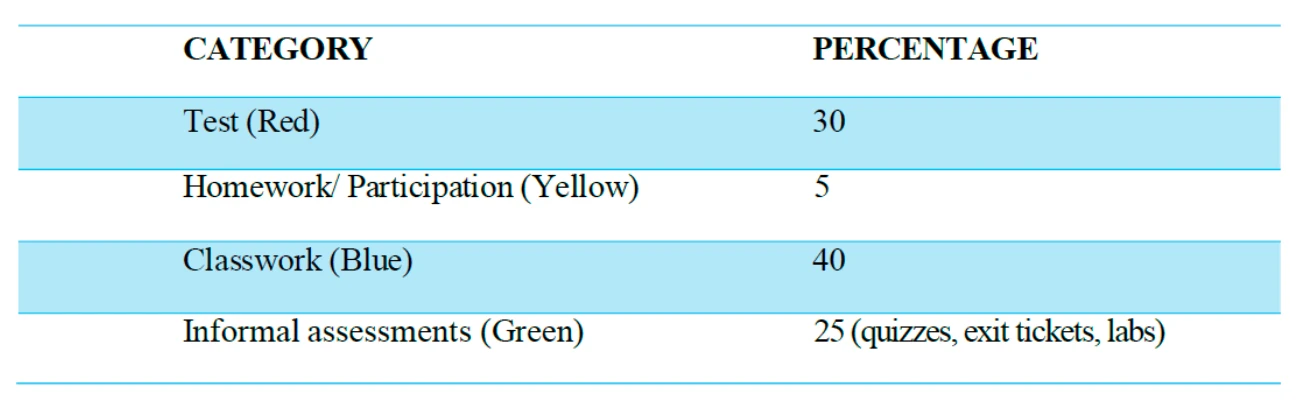
The four categories and assignment weights will apply to all courses in all subject areas.
Determinations for final grades are calculated as follows:
- If students missed assignments due to absences, they have the right and responsibility to complete assignments, quizzes, labs, or tests. Assignments must be completed within a reasonable time, usually within three days of being absent. Teachers and students may agree to alternative timelines for completing assignments
- Grades should be sufficient in number to justify the final grade for a course. For each class, teachers must assess student learning and record at least two grades per subject each week
- At least one test grade/informal assessment must be included per week
- Participation cannot be one of the two required grades per week
- Every Monday, administrators will check grades in Ascender
13.10 Parent-Teacher Communication Regarding Student Progress
The teacher should initiate a parent-teacher conference when a student is not progressing satisfactorily. This also includes sending a progress report when a student’s academic performance falls below 70%. Conferences should be scheduled during the teacher’s planning period and not during instructional time.
Samples of the student work, behavior log, attendance, and grades should be available for review. Always begin a conference on a positive note and allow parents to discuss their concerns. The teacher should be prepared to work with the parents to solve student concerns. Intervention and behavioral plans can be created for students during these conferences.
When a student is absent for three or more consecutive days, the teacher must contact the PEIMS coordinator at (713) 349-9945, extension #1164.
13.11 Family Educational Rights and Privacy Act
Student records are confidential and protected from unauthorized inspection or use. Employees with access to student information and/or performance data will consistently and uniformly maintain the privacy and confidentiality of this information in accordance with the Family Educational Rights and Privacy Act (“FERPA”).
13.12 Copy Room
Teachers will have a printing limit to the grade level printer. Please be ethical in following this rule. Administrator approval is required prior to any printing request. You may request copies by filling in and submitting a request form or sending it via e-mail.
13.13 Lamination
The lamination work will be completed on Friday. The teacher’s request must be received by Thursday.
13.14 Supply Request
If you need additional supplies (i.e., markers, scissors, tape, etc.), please fill out the supply request form found in the teacher’s workroom. If there is something you need that is not in our supply room, ask the immediate supervisor if it can be ordered.
Supply requests must be made on Monday by noon, and they will be filled in by Tuesday.
13.15 Textbook and Materials Acquisition
Any APV – FFL officer, administrator, or teacher who accepts a gift, favor, or service given to the person, or to APV – FFL that could not be lawfully purchased with funds from the state textbook fund, and that might reasonably tend to influence the person in the selection of a textbook, electronic textbook, instructional material, or technological equipment may commit a Class B misdemeanor offense.
Any APV – FFL director, administrator, or teacher who receives any commission or rebate on any textbooks, electronic textbooks, instructional materials, or technological equipment used by APV – FFL may commit a Class B misdemeanor offense.
13.16 Copyrighted Material
Employees are expected to comply with the provisions of federal copyright law relating to the unauthorized use, reproduction, distribution, performance, or display of copyrighted materials (i.e., printed material, videos, computer data and programs, etc.). Electronic media, including motion pictures and other audiovisual works are to be used in the classroom for instructional purposes only. Duplications are to be used in the classroom for educational purposes only. Duplication or backup of computer programs and data must be made within the provisions of the purchase agreement.
Employees acknowledge and understand that the entire right, title and interest of all writings, works and other creations that they may prepare, create, write, initiate or otherwise develop as part of their efforts while employed by APV – FFL shall be considered the property of APV – FFL.
The copies will be made no later than 24 hours from the day you requested. Submit legible/clear master copies with no staples or tape. Employees are expected to adhere to copyright laws and are personally liable for any copyright violations.The copies will be made no later than 24 hours from the day you requested. Submit legible/clear master copies with no staples or tape.
Employees are expected to adhere to copyright laws and are personally liable for any copyright violations.
14. GRIEVANCE AND COMPLAINT PROCEDURES
14.1 General Provisions
APV–FFL provides an orderly process for employees to resolve workplace concerns in a fair and timely manner. Employees are encouraged to resolve concerns informally with their immediate supervisor whenever possible.
If a concern is not resolved informally, the employee may file a formal complaint in accordance with this policy.
Complaints involving discrimination, harassment, or retaliation will be handled under applicable board policies and legal requirements.
Human Resources or other designated district personnel may assist in reviewing, investigating, and responding to complaints at any level of the grievance process. HR support may include policy guidance, coordination of investigations, and assistance in preparing written responses.
14.2 Complaint Definition
A “complaint” is a written grievance regarding:
- Employment conditions, including wages, hours, or working conditions; or
- Alleged violations of board policy or applicable law related to employment.
14.3 Business Days
A “business day” means a day the district’s central administrative office is open for business, regardless of student attendance. Time limits begin the first business day after receiving a complaint or response (Day 1).
14.4 Filing Procedures
Complaints and appeals must be submitted in writing using the district-approved form. Complaints may be submitted by:
- Hand delivery
- Email or electronic submission
- U.S. mail
Filing deadlines are based on receipt or postmark, as applicable. Late filings may be dismissed.
14.4.1 Level One – Supervisor or Campus Principal Review
An employee must file a written complaint within 15 business days of the date the employee knew or should have known of the issue.
The complaint must clearly state the facts and, when possible, include the requested resolution.
The principal or supervisor will review the complaint and issue a written response within 10 business days of receipt.
14.4.2 Level Two – Superintendent Review
If the employee is not satisfied with the Level One decision, the employee may submit a written appeal to the Superintendent within 10 business days of receiving the Level One response.
The appeal must include:
- The original complaint
- The Level One response
- A statement explaining the disagreement
No new issues may be introduced at this level.
The Superintendent or designee will issue a written response within 15 business days of receipt of the appeal.
14.4.3 Level Three – Board of Directors Review
If the employee is not satisfied with the Superintendent’s decision, the employee may appeal to the Board of Directors within 10 business days of receiving the Level Two response.
The appeal must be submitted in writing to the Board President and include all prior documentation.
The Board will review the complaint record in accordance with the Texas Open Meetings Act and may issue a decision based on that record. The Board’s decision is final.
14.5 Representation
An employee may be represented by another person, including an attorney, at any level of the grievance process.
Written notice of representation must be provided in advance of any scheduled conference. If notice is provided fewer than three (3) business days before a meeting, the district may reschedule the conference if necessary.
The district may also be represented by legal counsel or designated staff at any stage.
14.6 Consolidation of Complaints
Complaints arising from the same or related events may be consolidated into a single process. Duplicate or repetitive complaints may be dismissed or combined.
14.7 Untimely Filings
Failure to meet filing deadlines may result in dismissal of the complaint. Extensions may be granted only by mutual written agreement or as permitted by policy or law.
14.8 Response Requirements
All decisions must be issued in writing.
If additional time is needed for investigation, the employee will be notified in writing of the extension and revised deadline.
Failure to meet a deadline without written extension notice will be considered a denial at that level.
14.9 Costs
Each party is responsible for its own costs associated with the complaint process.
14.10 Documentation
Complaints must be submitted using district-approved forms. Supporting documentation should be included when available.
Additional documentation may be presented at Level One. New documentation will not be accepted at later levels unless it was not reasonably available earlier.
Incomplete complaints may be dismissed but may be refiled within applicable deadlines.
14.11 Nature of Process
This grievance process is administrative in nature and does not constitute legal proceedings. It is intended to provide an internal method for resolving workplace concerns.
14.12 Records Retention and Public Information Compliance
Employees are responsible for preserving all records created or received in the course of employment, including electronic communications, in accordance with the Texas Public Information Act and applicable records retention requirements.
Records may be stored on district or personal devices if used for official business.
Upon request, employees must provide responsive records to the district within 10 business days or as directed.
Failure to preserve or produce required records may result in disciplinary action and/or legal consequences.
Employees must ensure district-related records stored on personal devices are either:
- Forwarded to district systems, or
- Retained in accordance with applicable law
15. SEPARATION FROM EMPLOYMENT
15.1 Resignation and Termination
Employees are employed at will and can be dismissed without notice or warning.
All school-owned property in the employee’s possession must be returned to his or her supervisor upon separation from employment. Failure to return school-owned property constitutes theft of public property and will be reported to law enforcement.
In the event an employee has been terminated or resigned, it is the employee’s responsibility to provide a forwarding address and telephone number. This information must be provided to Human Resources no later than December 31 of that year for W-2 purposes, and no later than the last day of work in the event of termination or resignation. In the event the W-2 or final paycheck is returned to
APV – FFL, the school will hold the W-2 or the final check until claimed by the former employee or by an individual authorized in writing by the former employee to collect the check and/or the W-2.
Exit interviews will be scheduled for all employees leaving APV – FFL. Information on the continuation of benefits, release of information, and procedures for requesting references will be provided at this time.
15.2 Notice of Requirement
An employee voluntarily resigning from employment is requested to provide notice of resignation to his or her supervisor as follows:
- One-month advance notice of resignation by teachers and other exempt employees.
- Two weeks of advance notice of resignation by non-exempt employees
15.3 Arrest & Convictions During Employment
An employee must notify his or her Principal or immediate supervisor within two days or sooner, if possible, of any arrest, indictment, conviction, no contest or guilty plea, or other adjudication of any felony, and any of the other offenses listed below:
- Crimes involving school property or funds
- Crimes involving attempt(s) by fraudulent or unauthorized means to obtain or alter any certificate or permit that would entitle any person to hold or obtain a position as an educator
- Crimes that occur wholly or in part on school property or at a school-sponsored activity; or
- Crimes involving moral turpitude, please see board policy group 4 - Personnel Criminal History and Credit Reports PG-4.6
Moral turpitude includes but is not limited to: (a) dishonesty; (b) fraud; (c) deceit; (d) theft.
(e) misrepresentation; (f) deliberate violence; (g) base, vile, or depraved acts that are intended to arouse or gratify the sexual desire of the actor; (h) crimes involving any felony possession or conspiracy to possess, or any misdemeanor or felony transfer, sale, distribution, or conspiracy to transfer, sell, or distribute any controlled substance; (i) felonies including driving while intoxicated; and (j) acts constituting abuse or neglect under SBEC rules. If an educator is arrested or criminally charged, the Superintendent is also required to report the educator’s criminal history to the Division of Investigations at TEA.
The requirement to report a criminal history after employment begins shall not apply to minor traffic offenses. However, the first offense of DWI or DUI must be reported if the employee drives or operates (or is authorized to do so) an APV – FFL vehicle or other mobile equipment. Failure to report timely may result in disciplinary action, up to and including termination.
Conviction may not be an automatic basis for termination, unless the conviction makes an employee ineligible for employment in a Texas public school. APV – FFL shall consider the following factors (or other appropriate considerations as deemed by APV – FFL) in determining what action, if any, should be taken against an employee who is convicted of a crime during employment:
- The nature of the offense
- The date of the offense
- The best interests of APV - FFL and its students
15.4 Wage Withholding Orders
APV – FFL is required to report the termination of employees that are under court order or writ of withholding for child support or spousal maintenance to the court and the individual receiving the support (Texas Family Code §8.210, 158.211). Notice of the following must be sent to the court and support recipient:
- Termination of employment not later than the seventh day after the date of termination
- Employee’s last known address; and
- Name and address of new employer, if known
15.5 Termination Grievances Process
A terminated employee may request a review of the dismissal decision. Termination grievances (other than whistleblower complaints) must be submitted in writing to Human Resources within five calendar days of notice of termination.
The Human Resources representative will schedule and hold a conference within five business days of the request and shall issue a written decision within five business days after the conference. A former employee wishing to appeal against this decision may appeal through the General Employee Complaints and Grievances process described in Section 10 of this Handbook. Termination decisions will not be deferred pending the outcome of an appeal.
15.6 Return of Property, Record and Technology
- Upon leaving employment, or upon request from the Superintendent, employees must return any District-owned equipment or resources in employees’ possession
- Employees must also return any records, written or electronic, to the district for records retention if Employees have reason to believe Employees are retaining the sole copy of a record subject to records retention requirements
- Employees must destroy (delete or shred) any other confidential records remaining in employee’s possession
Financial responsibility may be less than this amount based on the nature of the damage and the age of the device. Keep in mind, this only applies when technology is used off school property or for personal business.
Board Approved: July 21, 2026

5.5 Social Media and Electronic Communication
5.5.1 Social media
Personal Accounts
APV – FFL prohibits employees from being friends or connecting with students on any social media platform such as Facebook, Twitter, Snapchat, Instagram and others, unless employees have an appropriate out-of-school relationship with the students such as relatives, church, scouts, or other activity that would be appropriate for such informal communication. (see also section 8.20) Staff must avoid posting student information, pictures, work product exemplars on personal social media sites, blogs, etc. Parental consents apply only to school-sanctioned sites. Be aware that even with the most stringent privacy settings, photo tagging and other tools may make personal information regarding students and their families publicly available.
When using personal social media sites, if employees identify employees self as an employee of the APV – FFL, employees must remember that employees have associated employee’s self with the school, Employees colleagues, and employees school community; therefore, employees’ online behavior must reflect the same standards of professionalism, respect and integrity as employees’ face-to-face communications. Employees must ensure that any associated content is consistent with the mission and work of the school. Employees must also respect all copyright and other intellectual property laws. For APV – FFL’s protection, as well as employees own, it is critical that employees show proper respect for the laws governing copyright, fair use of copyrighted material owned by others, trademarks, and other intellectual property, including APV – FFL’s own copyrights, trademarks, and brands.
Even with the most stringent privacy settings, when posting online comments that are related to school, students, or families, even in a personal capacity, staff should act as if all comments/postings are in the public domain. Use caution when posting any comment and/or images to the internet that may reflect negatively on Employees professional image. Be advised that failure to adhere to these guidelines may result in disciplinary action, up to and including termination.
Professional Accounts
When using social media sites/products for school related purposes, use APV – FFL sanctioned and/or created platforms, (e.g. APV – FFL Facebook page).
Staff should not communicate with parents and students with a personal phone number or email account. Professional communication between staff, students, and parents must be through a school approved program, or school provided device.
We encourage staff to establish “professional office hours” and share them with students and parents so that they know when Employees will respond to questions that are emailed, posted on social media, or otherwise communicated to staff.
If staff wishes to post student information, pictures, work product exemplars on personal social media sites, blogs, etc., they must first ensure a parental consent is on file with the school. must not post anything regarding a student without parental consent.
If an employee’s use of social media violates state or federal law or APV – FFL policy, or interferes with the employee’s ability to effectively perform his or her job duties or adversely impacts APV – FFL and its service to students and parents (as solely determined by APV – FFL), the employee is subject to disciplinary action, up to and including termination of employment.