



Table of Contents
- FOREWORD
- SCHOOL MISSION
- SCHOOL VISION
- THE LEARNER’S CREED
- Student Expectations
- RESPECT FOR SCHOOL PROPERTY AND FINES
- Support Requirements
- STUDENT ARRIVAL AND DISMISSAL PROCEDURES
- Attendance POLICY
- PROMOTION STANDARDS
- Student Dress Code and Personal Grooming
- PARENT DRESS CODE
- Student Responsibilities
- Cell Phones
- Right to Information and Privacy of Records
- Notification of Rights Under FERPA
- Media Release
- Student Discipline
- General Discipline Guidelines for Assessing Penalties
- General Procedures for Resolving School Problems
- LevelS of Student Misconduct and Disciplinary Options
- Level I: Violation of Classroom Rules
- Level II: Administrator Intervention
- Level III: Misconduct Resulting in Suspension/Removal from Classroom
- Level IV and Level V- Expulsion for Serious Offenses
- DISCIPLINE APPEAL PROCESS
- Corporal Punishment
- Bullying and Other Types of Harassment
- Code of Student Conduct and Parent Handbook
Code of Student Conduct and Parent Handbook 2026 - 2027
Neither the Code of Student Conduct and Parent Handbook nor any provision therein creates an obligation on the part of Amigos Por Vida – Friends for Life Public Charter School (APV-FFL).
Because no Code of Student Conduct and Parent Handbook can anticipate every
circumstance that may arise at the school, APV-FFL reserves the right to revise, supplement, or rescind any provisions and policies contained in the handbook.
FOREWORD
The School Board of “APV – FFL” has adopted this Code of Student Conduct and Parent Handbook (the “Code”) in accordance with Section 12.131 of the Texas Education Code, in order to clearly communicate standards for expected student conduct, the disciplinary consequences which may be applied to students who violate those standards, and the applicable procedures for the implementation of disciplinary consequences. All students must comply with the Code. Definitions of words and phrases used throughout this Code are provided at the end of the handbook.
Parents and students are encouraged to contact campus administration with any questions or concerns regarding the requirements and provisions of the Code. Parents and students are expected to review and be familiar with the provisions of the Code. Lack of knowledge or awareness about any School rules, including this Code, will not excuse violations of the Code. Parents and students will be required to sign a statement acknowledging receipt and understanding of the Code. A copy of this Code is available at the front office and at www.amigosporvida.com.
SCHOOL MISSION
Our mission at APV-FFL is to empower our students to become life-long learners and achieve academic and personal success, by providing an excellent education in a safe environment.
SCHOOL VISION
Our mission at APV-FFL is to empower our students to become life-long learners and achieve academic and personal success, by providing an excellent education in a safe environment.
THE LEARNER’S CREED
I believe in myself and my ability to do my best at all times. Today, I will be Responsible, Respectful, and Ready.
STUDENT EXPECTATIONS
Students and parents are expected to become familiar with the requirements of the district- wide Code of Student Conduct and Parent Handbook and the guidelines adopted by the district. Students are also expected to abide by the policies set forth in the Code so that they can truly get the most out of their years in school.
Commitment Contract
The purpose of this contract is to establish school, student, and parent/guardian expectations which will ensure that every student has the opportunity to have a successful school year.
APV-FFL Commitment:
Provide high-quality curriculum and instruction in a supportive and effective learning environment that enables the participating children to meet the State’s student academic achievement standards as follows:
- All classroom teachers are highly qualified, they are either certified in their content area or on a certification plan.
- All teachers teach the Texas Essential Knowledge Skills (TEKS).
- All teaTeachers follow the APV-FFL adopted curriculum.
- Teachers use best practices to ensure a rigorous education.
- All teachers will implement the Project Based Learning (PBL) program following the guidelines and expectations set by APV-FFL.
- All students have access to High-Quality Instructional Materials (HQIM)
- Hold parent teacher conferences during which this contract will be discussed as it relates to the individual child’s achievement.
- Parents may request to schedule appointments with teachers during their conference periods.
- Appointment requests may be made with the receptionist or via ClassDojo with the teachers.
- Teachers may request parent-teacher conferences to discuss academic progress, discipline issues, or any other factor affecting the wellbeing of the student.
- Provide parents with reports on their children’s academic progress as follows:
- Pre-K3, Pre-K4, and Kindergarten:
- Progress Reports will be sent home after 6 weeks.
- Report Cards will be sent home after 12 weeks.
- First through Eighth grade:
- Progress Reports will be sent home every four weeks.
- Report Cards will be sent home every seven weeks.
- Provide parents opportunities to volunteer and participate in their child’s class and to observe classroom activities, as follows:
- Volunteers may coordinate their time via the Family and Student support personnel.
PARENTS'/GUARDIANS' COMMITMENT
We fully commit to APV-FFL in the following ways:
- Arrival: ensure our child arrives at the school every day by 7:45 or by 7:15 a.m. if having breakfast.
- Dismissal: ensure that our child is picked up from school no later than 3:45 p.m. (Mon. - Fri.)
- Pick up our child on time if he/she participates in any after-school activities.
- Ensure our child will not exceed 6 absences per semester.
- Ensure our child will not exceed 5 tardies per semester.
- Make arrangements so our child can remain at APV-FFL for after school tutorials if needed.
- Make arrangements for our child to come to APV-FFL on Saturdays, if required.
- Ensure that our child attends APV-FFL summer school if required.
- Help our child in the best way we know and do whatever it takes for him/her to learn.
- We will check our child's homework when assigned and have them read at least 20 minutes every night.
- Send our child to school with the necessary school supplies so that he/she may be successful in school.
- Make ourselves available to our children, teacher, and school personnel.
- Notify the school as soon as we know that our child will be absent.
- Read carefully all the documents that the school sends home, including messages and messages via ClassDojo.
- Allow our child to go on APV-FFL field trips.
- Ensure our child follows the APV-FFL dress code.
- Parents or legal guardians will not use a cellphone or any electronic device while driving a vehicle in a school zone. According to the law, driving in a school zone while operating an electronic is prohibited. Violators are subject to be ticketed.
We understand that our child must follow the APV-FFL rules to protect the safety, interests, and rights of all individuals in the classroom. We, not the school, are responsible for the behavior and actions of our child.
Failure to adhere to these commitments can cause my child to lose various APV-FFL privileges and can lead to my child losing this/her space at our school.
STUDENT'S COMMITMENT:
I fully commit to APV-FFL in the following ways: I will:
- Arrive at APV-FFL every day by 7:45 A.M. or 7:15 AM if eating breakfast (Mon. - Fri.)
- Maintain an average of 70 or above in all my classes.
- Attend after school tutorials, Saturday tutorials and/or summer school if required.
- Work, think, and behave in the best way I know how, and I will do whatever it takes for me and my fellow students to learn.
- Complete, bring and submit all my homework when assigned.
- Raise my hand and ask questions in class when I do not understand something.
- Tell the truth to my teachers and accept responsibility for my actions.
- Follow the APV-FFL student code of conduct and follow the acceptable use policy.
- Respect all school property.
- Be ready for school with all necessary supplies.
- Follow the APV-FFL dress code.
- Be responsible for my own behavior.
- Follow the teachers’ directions.
Failure to adhere to these commitments can cause me to lose various APV-FFL privileges and lose my space at school.
Overwhelming evidence shows that when YOU are involved and engaged in the education of your child and give him/her the support necessary to make good decisions about progress made at school, he/she will become successful, perform better on test, and go on to high education. WE NEED YOUR HELP TO EDUCATE YOUR CHILD.
RESPECT FOR SCHOOL PROPERTY AND FINES
Students are expected to demonstrate respect for all school property and facilities at all times. This includes classrooms, restrooms, hallways, furniture, technology equipment, and outdoor spaces. Damaging, defacing, or misusing school property is considered a serious offense and may result in disciplinary consequences, including restitution for repairs or replacement.
The following are the associated fines to cover cleaning, repair, or restoration:
- Playing with paper, soap, or water in restrooms – Cleaning Fee / Fine: $25
- Making holes in walls (including kicking or punching drywall) – Fine: $100
- Writing on bathroom stalls, walls, or other surfaces – Fine: $25–$50
- Peeling or removing paint or wall coverings – Fine: $25–$50
These are the associated fines to repair technology equipment:
- Vandalizing devices (writing) - Fine of $25/$50
- Key removal - Fine of $25/$50
- Screen damage - Fine of $100
These fines are subject to change depending on the damage.
REQUIREMENTS FOR PROVIDING ASSISTANCE TO STUDENTS WITH LEARNING DIFFICULTIES OR IN NEED OF SPECIAL EDUCATION
- If a child is experiencing learning difficulties, the parent may contact the teacher to learn about the district’s overall general-education referral or screening system for support services. This system links students to a variety of support options, including referral for a Special Education evaluation. Students having difficulty in the regular classroom should be considered for tutorials/interventions, and other academic or behavioral support services that are available to all students.
- At any time, a parent is entitled to request an evaluation for Special Education services. Within fifteen (15) school days, the district must decide whether the evaluation is needed. If an evaluation is needed, the parent will be notified and asked to provide informed written consent for the evaluation. The district must complete the evaluation and the report within 45 calendar days of the date the district receives the written consent. The district must give a copy of the report to the parents. If the district determines the evaluation is not needed, the district will inform the parent why the child will not be evaluated. The notice will include a statement that informs the parent of his or her rights if he or she disagrees with the district. Additionally, the notice must inform the parent how to obtain a copy of the “Notice of Procedural Safeguards—Rights of Parents of Students with Disabilities.” If there are any questions, the parent may contact the Special Education Department.
STUDENT ARRIVAL AND DISMISSAL PROCEDURES
School hours are from 8:00am to 3:30pm. Breakfast will be from 7:15-7:45 a.m. After school clubs will be from 4:00 – 5:00 p.m. Students arriving after 8:05 a.m. will be considered tardy and must enter through the front door. Dismissal will be at 3:30 p.m. Parents must be on time picking up their children after school.
After-School Pickup Late Fee Policy
| After-School / Saturday School Pickup Late Fee Policy | ||
|---|---|---|
| Time After Dismissal | 1st Violation | 2nd Violation |
| 10 minutes late | $5 | $10 |
| 20 minutes late | $10 | $20 |
| 30+ minutes late | $15 | $30 |
If the parents refuse to pay the fine for the 1st or 2nd violation, the student will be removed from the afterschool club, but tutorial students will continue paying fines.
Morning Arrival
- Cafeteria doors open at 7:15 a.m. Car riders enter gate number 3 and walkers enter from pedestrian gates next to gate 1 and 2. Students who arrive after 8:00 a.m. will enter through the front office.
Dismissal Procedure
- To maximize instructional time and maintain an orderly school environment and safe dismissal, no student may be checked out of the office between 2:00 p.m. and 3:30. Your cooperation is appreciated.
WALKERS
- Parents must line up on the left side facing the front entrance.
- Designated older siblings must also join the pick-up line.
- Parents may not block the exit doors.
- Parents and teachers must not engage in conversation holding the line up.
BUS RIDERS
- Students will be picked up at 3:25 p.m. from classes.
- Designated personnel will escort the students to the respective buses.
CAR RIDERS
- Gate # 3 will open at 3:00 pm for parents to start lining up.
- Parents will enter through gate # 3, pick up their students from the loading stations and exit through gate # 4.
- It’s mandatory that all cars must display the car rider sign.
Note:
- Cell phone use is prohibited by law in the school zone area.
- After 4:00 p.m. students that are not picked up will be waiting in the front office.
ATTENDANCE POLICY
- APV-FFL has adopted an attendance policy, which is in compliance with the state guidelines for compulsory attendance found in Chapter 25 of the Texas Education Code.
- Regular attendance and punctuality are required of every student.
- Unless specifically exempted by TEC 25.086, a child who is at least six years of age or who is younger than six years of age and has had previously been enrolled in first grade, and who has not yet reached the child’s 19th birthday must attend school. (TEC 25.085(b).
- On enrollment in prekindergarten or kindergarten, a child must attend school. (TEC 25.085(c)).
APV-FFL’s attendance policy is as follows:
- Attendance is taken daily at 9:00am.
- Parents or guardians will be required to meet the attendance committee and receive a contract if there are six or more unexcused absences and five or more tardies and in the same semester. Students who arrive after 8:05 a.m. will be marked tardy.
- Absences will be considered excused for the following reasons if a written excuse is provided within three days:
- Illness
- Death in the family
- Doctor/dentist/court appointments (afternoon appointments are strongly encouraged)
- Religious holidays as allowed by law.
- Students who are absent three or more consecutive days must bring formal documentation excusing an absence (not a parent’s note).
Absences will be considered unexcused for the following reasons:
- Illness in household other than student
- Waking up late
- Transportation problems which are chronic or show a pattern of occurrence
- Family vacations or out-of-town situations which do not include activities described above as excused absences.
- Weather related issues (too cold or too hot). Other excuses deemed by the campus administrator.
Students are expected to make up work missed for all absences. With respect to family emergencies or prearranged absences, the parent or guardian must request homework assignments in advance.
PROMOTION STANDARDS
- Students shall be evaluated on a continuous basis in the most effective manner to determine the extent of their progress.
- Promotion expectations of APV-FFL are a minimum of 70 in all core subjects and meeting minimum standard on all state and local assessments.
- Please see the addendum for promotion standards by grade level.
STUDENT DRESS CODE AND PERSONAL GROOMING
The APV-FFL dress code is established to teach grooming and hygiene, instill discipline, prevent disruptive behavior, avoid safety hazards, and teach respect for authority.
Appropriate student dress and grooming are important factors in the safe and orderly operation of the school. Each student’s appearance should reflect a positive image of the school and contribute to a distraction-free learning environment. Our school values need the support of parents in upholding the campus dress and grooming guidelines.
All students are required to adhere to the school dress and grooming guidelines. Parents are expected to be knowledgeable and supportive of the dress and grooming guidelines.
-
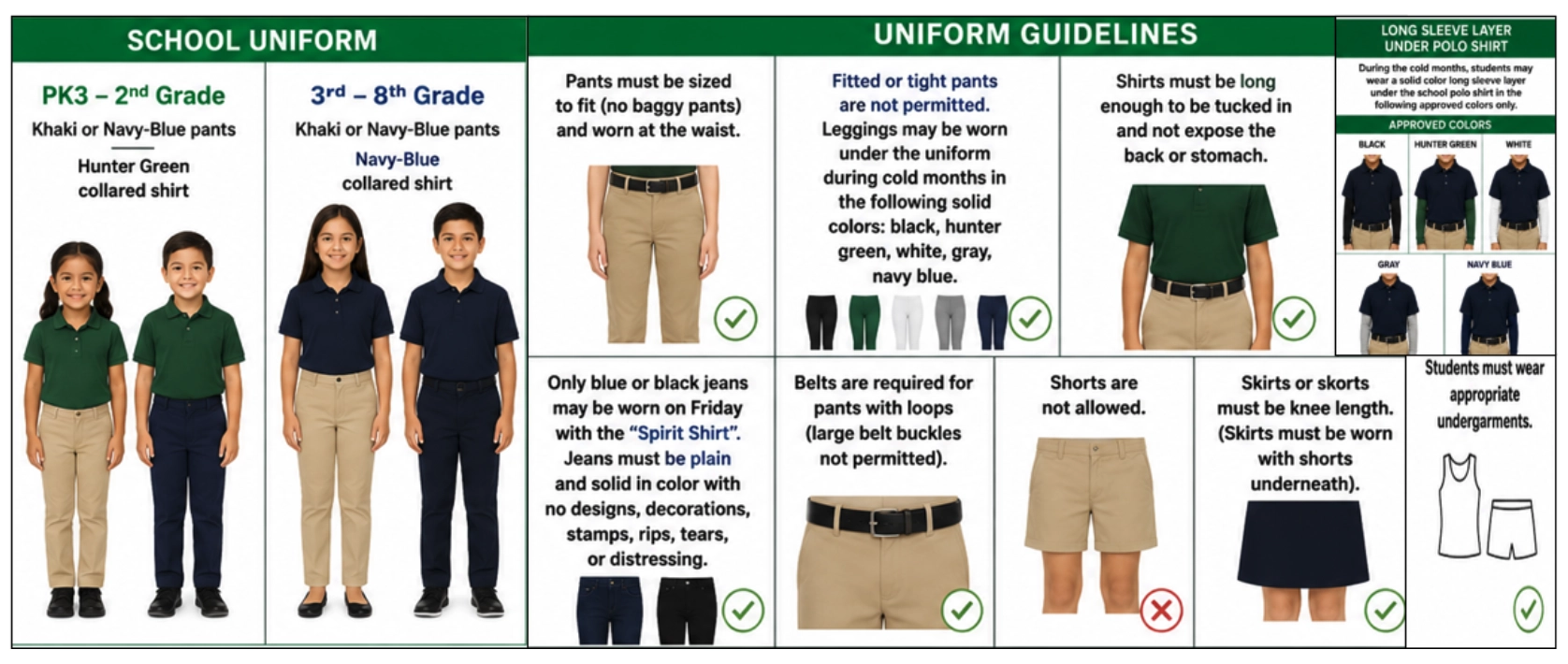
Students must wear the school uniform.
PK3-2nd grade: Khaki or Navy-Blue pants and hunter green collared shirt.
3rd-8th grade: Khaki or Navy-Blue pants and navy-blue collared shirt - Pants must be sized to fit (no baggy pants) and worn at the waist.
- Fitted or tight pants are not permitted. Leggings under the uniform may be used during the cold months in the following solid colors: black, hunter green, white, gray, navy blue.
- Shirts must be long enough to be tucked in and not expose the back or stomach.
- There should be no lace, ruffles, zippers, emblems, or designs of any kind visible on the polo shirts.
- Only blue or black jeans may be worn on Friday with the “Spirit Shirt”. Jeans must be plain and solid in color with no designs, decorations, stamps, rips, tears, or distressing.
- Belts are required for pants with loops (large belt buckles not permitted).
- Shorts are not allowed.
- Skirts or skorts must be knee length. (Skirts must be worn with shorts underneath).
- Students must wear appropriate undergarments.
FREE DRESS DAYS
- Students who receive a free dress pass must comply with the APV-FFL dress code.
- Students are not permitted to wear strapless or spaghetti strap shirts or dresses.
- Torn Jeans are not allowed.
- Shorts are not allowed.
- Students cannot wear garments with visual or written messages that are likely to cause disruption to the school environment. Examples of such prohibited visual or written messages include, but are not limited to drugs, alcohol, tobacco, weapons, violence, vulgar or obscene language or images, and/or insults to race, religion, gender, or ethnicity (Parents may bring a change of clothing or students may be sent home or required to wear the shirt inside out).
- A student is prohibited from wearing any form of dress or accessories identifying him or her with a gang or cult or symbolizing the beliefs of such a group.
- Students participating in school-related activities, such as extracurricular or UIL activities or other special functions, may have a different dress or grooming code required by the sponsor, coach, or administration.
- “College Day” will be on Wednesdays and “College Shirts” will be worn with the uniform pants for the students. Students must wear khaki or blue uniform pants with their college shirt.
- Shoes: sneakers, penny loafers, or saddle oxfords (no sandals, heels, etc.) – must be worn with socks. All sneakers and shoes must have shoelaces, which must be tied at all times.
- P.K and kinder may wear shoes with Velcro. Students must wear sneakers for dance, P.E. and structured recess.
- Male students may not wear earrings, loops, studs and/or any other ornament on their ears.
- Hair shall be kept clean and well groomed. A male’s hair shall not exceed below the eyebrow, bottom of the ear lobes or touch the shirt collar.
- “Mohawks” and haircuts with symbols and designs are considered disruptive and are not permitted.
- For safety and uniformity, hair height may not exceed 2 inches when measured from the scalp.
- Hair may not include shaved, cut, or styled designs, patterns, symbols, letters, or other decorative markings.
- The student's hair style/color and makeup must not distract from or interfere with the learning and school environment. Temporary/permanent hair dyes other than the student’s natural hair color and highlights are prohibited.
- Hair must be kept well groomed, neat, and clean at all times. Cuts, slits, or decorative designs in the eyebrows are not permitted.
- No type of head covering is to be worn. Exceptions would be a cap or hat that is part of a uniform worn at a school activity or a head covering worn for religious or medical purposes. Examples of prohibited head covering according to the guidelines include, but are not limited to scarves, hoods, hats, caps, sweatbands and bandanas.
- Male students may not have any facial hair.
- Overalls or similar clothing are not allowed.
- Garments with hoods are not allowed.
- Students may only wear the “APV-FFL logo Jacket”.
- Noisy, distracting, flashy, or excessive jewelry or accessories, including wallet chains, are prohibited. Multiple rings and bracelets are not acceptable. Examples include, but are not limited to medallions, big chains or ropes with emblems attached, long chain that extend below the mid-section of the body, etc.).
- The school district will not be held responsible for any lost or damaged jewelry.
- Earrings are allowed for girls only and limited to a maximum of one earing per ear. All other body piercing jewelry is strictly prohibited. All students are forbidden to wear any visible body piercing ornaments including jewelry on the ear, nose, eyebrows, lips and/or tongue or any other body part.
- Permanent or temporary body tattoos are prohibited. Glitter on any part of the body is also not permitted.
- Girls are not allowed to wear fake/false nails or nail tips, make-up (foundation, blush, eye shadow, eyeliner, lip liner, lipstick, mascara, false eyelashes etc.), or lip-gloss with glitter and/or color appearance. Acrylic nails, short or long, are not allowed at any time except for the 8th grade graduation ceremony. (NO ACRYLIC NAILS DURING 8TH GRADE WEEK)
- Any other dress deemed inappropriate by a school administrator that may be offensive, vulgar, unsafe, disruptive, or distracting in the school’s learning environment will not be permitted while on campus or when attending school related events.
Any student not in compliance with the dress code will have the chance to call home to get suitable clothing. School officials may use other appropriate consequences as designated in the student code of conduct. Parents who have a question about the appropriateness of an item should discuss the specific issue with the appropriate staff member before wearing the item.
Compliance with these guidelines is expected every day, including the first day of school. Students who are new to the campus, or students with extenuating circumstances, will be expected to be in compliance after a reasonable grace period, provided the grace period is approved by the principal.
Students are expected to follow the appropriate district dress and grooming guidelines. No Exceptions!
PARENT DRESS CODE
Parents are a child’s first role models, and the staff at APV-FFL strive to mirror that positive influence for every student. To maintain a respectful learning environment, we kindly ask parents and volunteers to dress in professional or smart-casual attire when attending school events, conferences, meetings, or chaperoning field trips.
Please ensure your attire follows these guidelines:
- Wear standard daywear rather than sleepwear or pajamas.
- Choose closed-toe shoes or supportive sandals instead of flip-flops or slippers.
- Ensure all undergarments are completely covered.
- Avoid sheer, see-through, or overly revealing clothing.
- Opt pants, skirts, or dresses instead of shorts.
VOLUNTEER GUIDELINES
- Volunteers must be approved by the School Counselor and must pass a background check. The school will accept applications from August to September 30th (After this time a $10.00 fee will be charged).
- Sign in and out every time you are on campus volunteering.
- If you are doing volunteer work at home, there is also a sign-in sheet to capture your hours.
- When on campus wear the volunteer badge.
- If you need a place to do your volunteer work, there is a WORK ROOM located on the second floor for your use.
- Report only to your assigned area. Do not go to the classrooms without prior approval.
- Please adhere to the Parent Dress Code while on campus and any time you are representing APV-FFL
- Young children may not accompany parents while volunteering on campus
STUDENT RESPONSIBILITIES FOR USING NETWORK AND OTHER ELECTRONIC RESOURCES
The use of APV-FFL computers, computer systems, computer networks, software, and Internet is to support research and education in and among academic institutions by providing access to unique resources and the opportunity for collaborative work. The use of APV-FFL computers, computer systems, computer networks, software, and Internet is a privilege, not a right, and inappropriate use will result in a cancellation of those privileges. The system and building administrators will deem what is inappropriate use, and their decision and the consequences are final.
Technology usage and maintenance:
Network Standards
- Using the network resources in such a way that would disrupt the use of the network is prohibited. (Social media, non-instructional web browsing, online games, or unauthorized messaging via teams).
- Follow teacher guidelines and instructions on appropriate use of network resources.
- Using inappropriate language such as swearing or vulgarity, or ethnic or racial slurs, or obscene material is prohibited.
- Typing messages in all capital letters is the computer equivalent of shouting and is considered rude.
- Revealing personal information of yourself or others is prohibited.
- Always log off from iPads/Computers that requires your personal log in information when your session is completed, after finishing your session put the assigned equipment to charge.
- Sharing your issued username and password for any website is prohibited.
- Individuals using the APV-FFL computer system and network, with or without authorization are subject to, and consent, to having their activities monitored and recorded by authorized system personnel.
Internet Acceptable Use
- Follow teacher guidelines and instructions on appropriate use of the Internet.
- Access only course related materials for educational purposes.
- Credit all resources appropriately when utilizing information accessed (observe copyright guidelines).
- Refrain from using Peer Edited Resources as Wikipedia
- APV-FFL prohibits any social media relationships between students and APV-FFL staff members.
Use of Data
- It is a violation to knowingly attempt to access resources that you do not have permission to utilize or should not have access to as required for schoolwork.
- It is your responsibility to report to your instructors, instances where you have access to data/resources that are not part of your schoolwork.
- “Hacking”, unauthorized use, or attempts to circumvent or bypass the security mechanisms of an information system or network of any kind are in violation of the APV-FFL Code of Conduct.
- All data contained in the APV-FFL network is monitored, and can be intercepted, recorded, read, copied, or captured and disclosed in any manner by authorized personnel.
Restrictions
- Installing any software to the district’s network system is prohibited.
- Copying and distribution of unauthorized materials such as but not limited to video, audio, and image files is prohibited.
- Damaging and vandalizing computers, computer systems or computer networks is prohibited.
- Accessing and using non-district provided email is strictly prohibited.
Copyright of Print/Non-Print Materials
- Use of printed copies either from books or downloaded from electronic sources must be properly cited.
- Copies may not be substituted in part or whole for an original work.
- Copying software is illegal.
- Student must not reproduce or print any copyrighted materials.
Disclaimers
Please note that since the Internet provides access to computers and people all over the world there is a possibility that students may encounter areas of adult content and objectionable material. While the district will take reasonable steps through training to preclude access to such material and does not encourage such access, it is not possible to absolutely prevent such access.
APV-FFL makes no warranties of any kind, either expressed or implied, for the provided access.
- The staff, faculty, and school are not responsible for information obtained through district network resources resulting in criminal or terrorist activities.
- Parents who do not wish for their children to have individual access to the Internet must submit to the campus principal a written letter expressing their desire for their child to be exempt from individual Internet access.
Anyone using the APV-FFL computer system and network expressly consents to monitoring and, if such monitoring reveals possible evidence of criminal activity, system personnel may provide the evidence to law enforcement officials and could result in fine, imprisonment, or both. Unauthorized access or use of the APV-FFL computer system and network may result in disciplinary actions including suspension and even expulsion from the school.
RIGHT TO INFORMATION AND PRIVACY OF RECORDS
- Students are assured the right to information and privacy of their records in accordance with the Texas Public Information 5 Act and the Family Educational Rights and Privacy Act of 1974.
- Parents or eligible students have the responsibility to release information to those individuals or agencies that are working actively and constructively for the benefit of the student, including, for example, teachers, administrators, school nurses, etc.
NOTIFICATION OF RIGHTS UNDER FERPA
Directory Information Notice
The Family Educational Rights and Privacy Act (FERPA), a federal law, requires that APV-FFL, with certain exceptions, obtain your written consent prior to the disclosure of personally identifiable information from your child’s education records. However, APV-FFL may disclose appropriately designated “directory information” without written consent, unless you have advised the open-enrollment public charter to the contrary in accordance with charter school procedures. The primary purpose of directory information is to allow APV-FFL to include this type of information from your child’s education records in certain school publications.
Examples include:
- A playbill, showing your student's role in a drama or dance production
- The school newsletter
- Honor roll or other recognition lists
- Graduation programs
- Sports activity sheets or t-shirts, such as for soccer, showing weight and height of team members.
Directory information, which is information that is generally not considered harmful or an invasion of privacy if released, can also be disclosed to outside organizations without a parent’s prior written consent. Outside organizations include, but are not limited to, companies that print t-shirts or awards. In addition, two federal laws require local educational agencies (LEAs)
receiving assistance under the Elementary and Secondary Education Act of 1965 (ESEA) to provide military recruiters, upon request, with three directory information categories – names, addresses and telephone listings – unless parents have advised the LEA that they do not want their student’s information disclosed without their prior written consent.
If you do not want APV-FFL to disclose directory information from your child’s education records without your prior written consent, you must notify APV-FFL within 30 days of enrollment. APV- FFL has designated the following information as directory information:
- Student's name
- Participation in officially recognized activities and sports
- Address
- Dates of attendance
- Telephone number
- Weight and height of members of athletic teams
- Electronic mail address
- Honors and awards
- Photograph
- Grade level
- Date and place of birth
MEDIA RELEASE
Students may participate and appear in video or audio recordings, films, photographs, written articles, or on websites and social media sites. This consent includes the use and editing of a student’s image, voice and name in media projects by APV-FFL to print, broadcast or Internet media outlets, such as newspapers, radio and television stations and news websites. If you DO NOT wish for your child to participate in any of these activities, the PEIMS Coordinator must be notified in writing. Otherwise, it will be understood that APV-FFL, including its employees and contractors, will be released from all claims resulting from the use of this information.
Parent-signed media releases are NOT needed when:
- Photographing or videotaping anonymous students engaged in normal classroom/ school activities.
- Photographing, videotaping or interviewing students at events that are open to the public, such as music, theater or athletic events.
Parent-signed media releases are ALWAYS needed when:
- Students are interviewed or will be identified by name in a photograph/news article.
- An individual student(s) is the focus of the story.
- Photographing, videotaping or interviewing students who are in special education classes/ services or certain specialized programs (drug/alcohol, detention/work detail, etc.).
- You feel that the photograph, videotape or interview may be used in a negative way.
STUDENT DISCIPLINE
STUDENT MISCONDUCT
- The Code of Student Conduct and Parent Handbook provides a description of a broad range of behavior considered to be student misconduct. The behavior described should be viewed as representative of the misconduct that most frequently causes a disruption to the orderly educational process. The acts of misconduct listed in Levels I, II, III, IV, and V are not inclusive. The student who commits an act of misconduct that may be classified into any of the five levels will be subject to disciplinary action by the classroom teacher, Assistant Principal, and/or Principal.
When and Where These Rules Apply
- The policies and administrative procedures concerning Code of Student Conduct and Parent Handbook apply to actions of students on school property, and, in some cases, for conduct occurring off school property. Under state law, a student may be expelled by APV-FFL for Level V misconduct that occurs on the property of another school district within Texas. Additionally, the rules apply to actions of students at all school-sponsored or school-related activities or events, such as field trips, sporting events, stadium assemblies, fairs, or evening school-related activities. Students should be aware that the commission of any felony offense, whether at school or away from school, may result in placement of the student in an APV-FFL expulsion. Finally, students should be aware that administrators who are made aware of criminal activity whether on or off campus will make a report to appropriate law enforcement agencies and that, in addition to these administrative rules, students may be subject to criminal charges for violations of the law.
Gang-Free School Zone
In addition to regular discipline, students should be aware that APV-FFL is a “gang-free school zone.” HB 2086 of the 81st Legislature established gang-free school zones and provides for enhanced punishment for gang-related criminal activity occurring in, on, or within 1,000 feet of any real property that is owned, rented, or leased by a school or school board.
INVESTIGATION OF DISCIPLINE ISSUES
In order to determine whether a violation of the code has occurred, campus administrators or other authorized individuals may conduct an investigation. Investigations of student misconduct may involve, but are not limited to, interviews of other students, employees and adults, review of school surveillance footage, review of relevant documents, review of information on School- owned computers, verification of tips received from other individuals, gathering of physical evidence, contact of or cooperation with law enforcement agencies and officials. Law enforcement may be contacted and informed of student conduct which may constitute a criminal offense.
Students should have no expectation of privacy with respect to School-owned property. Lockers, desks, and other items provided for student use remain School property, and students do not have a reasonable expectation of privacy in School property or in personal items placed inside School property. School administrators or other authorized personnel may monitor and search student desks and lockers for any reason. School officials may search any School property, including School property that is within a student’s possession or otherwise being used by a student, at any time, with or without notice to the student and without consent. School officials may confiscate any items found during a search, including prohibited items, dangerous items or other items that violate School policy.
A student’s person or property may be searched by authorized school officials if the official has a reasonable belief that the search will result in the discovery of evidence of a violation of the Code or of the law. Any personal property which is brought onto school property or to a school- sponsored or school-related activity or event, on or off school property, may be subject to search (e.g., student cell phone, backpack, personal computer, purse, car, etc.).
Education during Suspension
Student absences while suspended shall be considered as excused absences.
Students have the responsibility to make up all work missed while suspended within five school days after their return to school from suspension in order to receive credit for the work.
PROMOTION STANDARDS
- Students shall be evaluated on a continuous basis in the most effective manner to determine the extent of their progress.
- Promotion expectations of APV-FFL are a minimum of 70 in all core subjects and meeting minimum standard on all state and local assessments.
- Please see the addendum for promotion standards by grade level.
PROMOTION STANDARDS
- Students shall be evaluated on a continuous basis in the most effective manner to determine the extent of their progress.
- Promotion expectations of APV-FFL are a minimum of 70 in all core subjects and meeting minimum standard on all state and local assessments.
- Please see the addendum for promotion standards by grade level.
PROMOTION STANDARDS
- Students shall be evaluated on a continuous basis in the most effective manner to determine the extent of their progress.
- Promotion expectations of APV-FFL are a minimum of 70 in all core subjects and meeting minimum standard on all state and local assessments.
- Please see the addendum for promotion standards by grade level.